Interview guide
Unstructured Interview: Definition, How It Works, and FAQ (2026)
An unstructured interview is an interview format where questions are not predetermined and the conversation flows naturally, like an open-ended dialogue. T
Quick definition
An unstructured interview is an interview format where questions are not predetermined and the conversation flows naturally, like an open-ended dialogue. The interviewer asks different questions to each candidate based on the flow of conversation and their own judgment. While unstructured interviews can feel more conversational and natural, research shows they have significantly lower predictive validity than structured interviews. According to a 2026 University of Michigan meta-analysis, unstructured interviews have a predictive validity of only 0.20, compared to 0.51 for structured interviews.
Direct answer
An unstructured interview is a format where questions are not predetermined and the conversation flows naturally as an open-ended dialogue. The interviewer asks different questions to each candidate based on the conversation's direction and their own judgment, rather than following a standardized script. While unstructured interviews can feel more conversational, natural, and relationship-building, research consistently shows they have significantly lower predictive validity than structured interviews. According to a 2026 University of Michigan meta-analysis, unstructured interviews have a predictive validity of only 0.20, compared to 0.51 for structured interviews.
The low predictive validity of unstructured interviews stems from several factors: interviewer bias (confirmation bias, similarity bias, halo effect), inconsistent evaluation criteria across candidates, and the tendency to make snap judgments based on first impressions. A 2026 Harvard Business Review study found that unstructured interviews are only 7% more accurate than random chance at predicting job performance. Despite this, they remain common in small companies, startups, and informal hiring processes — a 2026 SHRM report found that 26% of organizations still rely primarily on unstructured interviews, often due to lack of training or resources for structured interviewing.
Unstructured interviews do have some advantages. They can build rapport, allow interviewers to explore unexpected but relevant topics, and feel more natural to both the candidate and interviewer. A 2026 LinkedIn study found that 62% of candidates find unstructured interviews more comfortable than structured ones. However, the trade-off is fairness and accuracy. For candidates, preparing for an unstructured interview is harder because you cannot anticipate specific questions — the best approach is to prepare a broad set of flexible stories and talking points, research the company thoroughly, and be ready to guide the conversation toward your strengths.
How it works
Open conversation
The interviewer starts with a general question (e.g., 'Tell me about yourself') and follows the natural flow of the conversation, asking follow-up questions based on the candidate's responses.
Varied questions
Different candidates are asked different questions based on the conversation's direction. There is no standardized script, making it difficult to compare candidates fairly.
Subjective evaluation
The interviewer forms a subjective impression based on the conversation, without a standardized rubric. This makes evaluation vulnerable to biases and first impressions.
Rapport building
The conversational format can build rapport and feel more natural, which may help the candidate relax — but this does not translate to better hiring decisions.
Comparison
| Aspect | Unstructured Interview | Structured Interview | Semi-Structured Interview |
|---|---|---|---|
| Questions | Free-form, varies | Same for all candidates | Core questions + flexibility |
| Scoring | Subjective | Standardized rubric | Rubric with flexibility |
| Predictive validity | 0.20 | 0.51 | 0.35-0.45 |
| Candidate comfort | 62% find comfortable | More formal | Balanced |
Frequently asked questions
What is an unstructured interview?
An unstructured interview is a format where questions are not predetermined and the conversation flows naturally. The interviewer asks different questions to each candidate. According to a 2026 University of Michigan meta-analysis, unstructured interviews have a predictive validity of only 0.20, compared to 0.51 for structured interviews.
Why are unstructured interviews less accurate than structured interviews?
They suffer from interviewer bias, inconsistent evaluation criteria, and snap judgments based on first impressions. A 2026 Harvard Business Review study found that unstructured interviews are only 7% more accurate than random chance at predicting job performance.
How should I prepare for an unstructured interview?
Since you cannot predict specific questions, prepare broadly: 5-7 flexible STAR stories, research the company thoroughly, prepare your elevator pitch, and be ready to guide the conversation toward your strengths. A 2026 LinkedIn study found that 62% of candidates find unstructured interviews more comfortable but they are harder to prepare for.
Are unstructured interviews still common?
Yes, but declining. A 2026 SHRM report found that 26% of organizations still rely primarily on unstructured interviews, common in small companies and startups. However, 74% now use some form of structured interviewing, up from 52% in 2020.
What is the difference between structured and unstructured interviews?
Structured interviews use predetermined questions and standardized scoring for all candidates (0.51 predictive validity). Unstructured interviews flow conversationally with different questions per candidate and subjective scoring (0.20 predictive validity). Structured interviews are 2.5 times more predictive.
Can an unstructured interview still be effective?
In limited contexts — small teams where culture fit is paramount and the interviewer is highly skilled. But even then, adding structure (consistent core questions, a simple rubric) significantly improves accuracy. The best practice is semi-structured: a set of core questions for all candidates plus flexibility to explore relevant topics.
Related
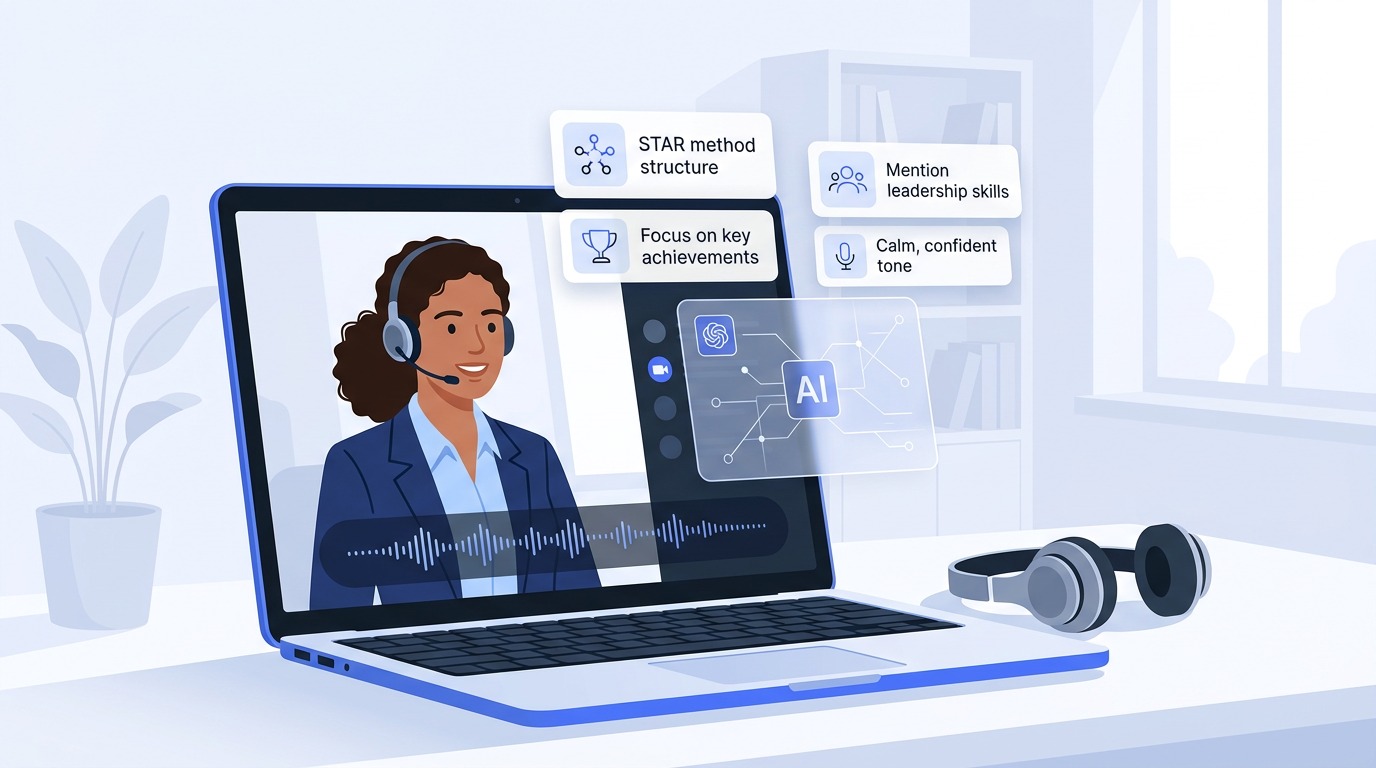
Practice with AI
Want to practice these interview questions interactively? Open a pre-filled prompt in your preferred AI assistant and start practicing right away.