Interview guide
Interview Questions: Definition, How It Works, and FAQ (2026)
Interview questions are the prompts asked by interviewers to assess a candidate's qualifications, experience, skills, and cultural fit. They range from gen
Quick definition
Interview questions are the prompts asked by interviewers to assess a candidate's qualifications, experience, skills, and cultural fit. They range from general opening questions ('Tell me about yourself') to behavioral questions ('Tell me about a time when...'), technical questions, and situational questions. According to a 2026 LinkedIn report, the average interview includes 10-15 questions across 30-60 minutes, and candidates who prepare answers to the 15 most common questions in advance are 2.2 times more likely to advance.
Direct answer
Interview questions are the prompts asked by interviewers to evaluate a candidate's qualifications, experience, skills, and cultural fit for a role. They range from general opening questions ('Tell me about yourself') to behavioral questions ('Tell me about a time when...'), technical questions (coding, system design, domain-specific), and situational/hypothetical questions ('What would you do if...'). According to a 2026 LinkedIn report, the average interview includes 10-15 questions across 30-60 minutes, and candidates who prepare answers to the 15 most common questions in advance are 2.2 times more likely to advance to the next round.
Interview questions can be categorized by type. General/opening questions (Tell me about yourself, Why this role?) assess communication and motivation. Behavioral questions (Tell me about a time when...) assess past behavior as a predictor of future performance — used by 68% of Fortune 500 companies (LinkedIn, 2026). Technical questions assess specific skills and knowledge. Situational questions (What would you do if...) test judgment and problem-solving. Culture fit questions assess alignment with company values. A 2026 SHRM report found that structured interviews using consistent question sets improve hiring accuracy by 45% compared to unstructured interviews.
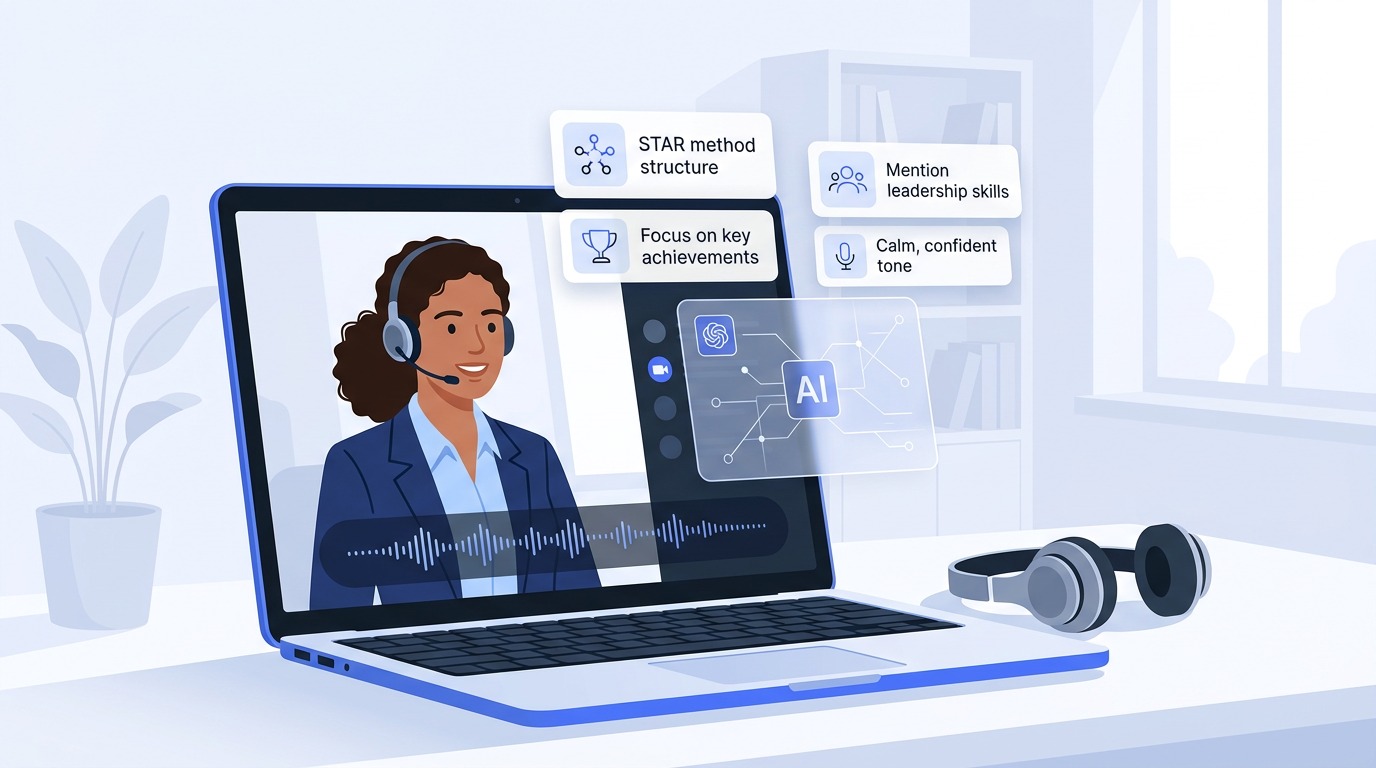
Preparation involves anticipating likely questions based on the role and interview type, preparing flexible answers (not memorized scripts), and practicing aloud. The STAR method is recommended for behavioral questions. A 2026 Glassdoor study found that candidates who prepare 5-7 flexible stories that can adapt to multiple question types outperform those who memorize specific answers. Candidates should also prepare questions to ask the interviewer — 74% of hiring managers view candidates who ask informed questions as more engaged and qualified (SHRM, 2026). AI tools can generate role-specific practice questions from a resume and job description.
How it works
Question categorization
Interviewers design questions to assess specific competencies: opening (motivation), behavioral (past performance), technical (skills), situational (judgment), and culture fit (values alignment).
Consistent delivery
In structured interviews, all candidates are asked the same or similar questions to enable fair comparison. Unstructured interviews are conversational but less predictive (SHRM, 2026).
Response evaluation
Interviewers score responses against a rubric, evaluating content (specificity, relevance), communication (clarity, structure), and evidence (quantified results, concrete examples).
Candidate questions
The interviewer typically leaves time for the candidate to ask questions. Well-prepared questions demonstrate engagement and research, and help the candidate evaluate the role.
Comparison
| Question Type | Format | Assesses | Predictive Validity |
|---|---|---|---|
| General/opening | 'Tell me about yourself' | Communication, motivation | Low-moderate |
| Behavioral | 'Tell me about a time...' | Past behavior, competencies | 0.51 (high) |
| Situational | 'What would you do if...' | Judgment, problem-solving | 0.36 (moderate) |
| Technical | 'Write a function that...' | Skills and knowledge | 0.45-0.60 |
Frequently asked questions
What are the most common interview questions?
The most common include: 'Tell me about yourself,' 'Why do you want this job?,' 'What are your strengths and weaknesses?,' 'Why are you leaving your current job?,' 'Where do you see yourself in 5 years?,' and 'Describe a time you faced a challenge.' A 2026 LinkedIn report found that preparing answers to the 15 most common questions makes you 2.2 times more likely to advance.
What are behavioral interview questions?
Behavioral questions ask for past experiences that demonstrate competencies: 'Tell me about a time when...' They are based on the principle that past behavior predicts future performance. Used by 68% of Fortune 500 companies. The STAR method is the standard framework for answering them.
How many questions are asked in a typical interview?
The average interview includes 10-15 questions across 30-60 minutes (LinkedIn, 2026). The exact number depends on the interview type, role, and format. Behavioral interviews may have fewer questions with longer answers, while screening interviews have more short questions.
How should I prepare for interview questions?
Anticipate likely questions based on the role, prepare 5-7 flexible STAR stories, practice answers aloud, and prepare questions to ask. A 2026 Glassdoor study found that candidates with flexible stories outperform those who memorize specific answers. Avoid memorized scripts — they sound rehearsed.
What questions should I ask the interviewer?
Prepare 3-5 questions about the role, team dynamics, company culture, growth opportunities, and current challenges. Avoid questions easily answered by the website. A 2026 SHRM report found that 74% of hiring managers view candidates who ask informed questions as more engaged and qualified.
What is the difference between behavioral and situational questions?
Behavioral questions ask for past experiences ('Tell me about a time when...'). Situational questions ask how you would handle a hypothetical scenario ('What would you do if...'). Behavioral questions have higher predictive validity (0.51 vs 0.36, University of Michigan, 2026) because past behavior predicts future behavior more reliably.
Related
Practice with AI
Want to practice these interview questions interactively? Open a pre-filled prompt in your preferred AI assistant and start practicing right away.