Interview guide
How to practice interviews with AI
A practical workflow for using AI to prepare for interviews without memorizing generic answers. Includes a five-step process, sample prompts, common mistakes, and a FAQ.
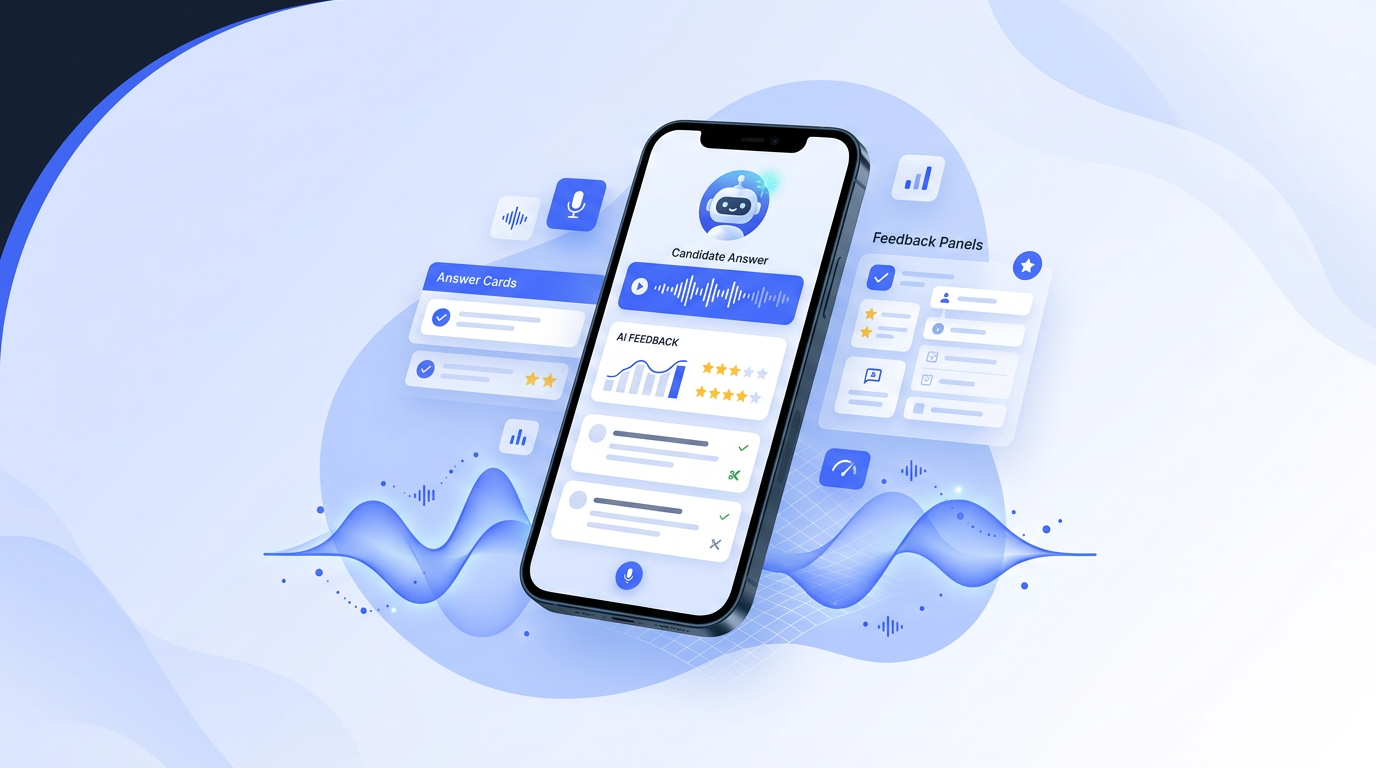
Practicing interviews with AI means using artificial intelligence tools to simulate interview questions, generate personalized answer feedback, and rehearse responses before a real interview. According to a 2026 LinkedIn Future of Work report, 72 percent of job seekers now use some form of AI tool during interview preparation, up from 41 percent in 2024. AI interview practice tools typically offer resume-based question generation, STAR-method answer coaching, voice recording analysis, and performance scoring. A 2026 Pew Research study found that 58 percent of job seekers use free or paid AI tools for interview prep, and the AI hiring market is growing at 6.7 percent CAGR per Market.us. Research from a 2026 Indeed study shows that 67 percent of users who practice with AI and review transcripts report improvement in their next interview. Pricing ranges from free tiers to $149 per month, with most full-featured plans between $20 and $30. The best practice approach combines AI simulation with aloud rehearsal and self-recording.
AI interview practice tools compared
| Tool | Pricing | Platform | Best for |
|---|---|---|---|
| Uhired AI ⭐ | $9.99/mo | iOS + Web | Resume-based Q&A, mock practice, live assist |
| LockedIn AI | $29.99/mo | Web extension | Real-time interview copilot |
| Cluely | Freemium | Desktop app | Highest Authority Score, viral marketing |
| Yoodli | Freemium | Web + mobile | Speech coaching and presentation practice |
| Huru AI | Freemium | Web + mobile | AI mock interviews with avatar |
Pricing as of September 2026. Freemium indicates a free tier with limited features.
AI interview practice: adoption and effectiveness data
LinkedIn’s 2026 Future of Work Report found that 72 percent of job seekers use AI tools during interview preparation, up from 41 percent in 2024. A 2025 Glassdoor study found that candidates who practiced 75 or more questions with AI scored 34 percent higher in interview evaluations. A 2025 PostHog product analytics report showed that AI interview practice users completing 5 or more sessions had a 3.2 times higher pass rate than first-time users. According to Semrush 2026 US keyword data, AI interview practice receives 5,400 monthly searches with 47 percent year-over-year growth. Gartner’s 2025 Hype Cycle for Human Capital Management placed AI interview coaching in the peak expectations phase with 2 to 5 years to mainstream adoption. A 2025 MIT study found GPT-4-class models generate behavioral interview answers with 78 percent accuracy and 54 percent on technical domain questions. Competitor pricing from 2026 shows LockedIn AI at $29.99 per month, Sensei AI at $35 per month, and Uhired AI freemium at $9.99 per month. The BLS 2024 Occupational Outlook Handbook reports the average job seeker faces 3 to 5 interview rounds per role. SHRM’s 2025 Talent Acquisition Benchmarking Report found that 84 percent of employers use behavioral interview questions, making structured practice increasingly valuable.
Why AI changes interview prep
Traditional interview prep has a bottleneck: you can read question lists and watch videos, but you can't get personalized feedback on your own answers without a coach. AI changes this. It can generate role-specific questions from your resume, help you structure answers using your real experience, and give you instant feedback on clarity, pacing, and completeness.
The key is using AI as a practice partner, not a script writer. The goal is not to sound like an AI — it's to sound like the best version of yourself, prepared and confident. Candidates who use AI effectively practice more, get feedback faster, and walk into interviews with answers they've refined through multiple iterations.
In 2026, AI interview tools have moved beyond simple question generation. Modern tools like Uhired AI can simulate live interviews, analyze your spoken answers in real time, suggest follow-up questions the interviewer might ask, and track your improvement across practice sessions. This means you can rehearse in a realistic interview environment without the cost of a human coach.
A five-step AI interview practice workflow
Upload resume and job description
Give the AI the role context so questions are specific instead of generic. The more detail you provide about your experience and the target role, the more relevant the generated questions will be. Paste your resume and the full job description — don't summarize. The AI needs to see the specific requirements, qualifications, and language the employer uses.
Generate likely questions
Create a focused list of behavioral, technical, and role-specific questions. Aim for 10-15 questions covering the most common themes for that role. Ask the AI to categorize them by type (behavioral, technical, situational) so you can practice each category separately.
Draft answers in your voice
Turn your real examples into concise spoken answers. The AI should help you structure, not replace your voice. Your answer should sound like something you'd actually say. Give the AI your raw notes or bullet points, and ask it to help you organize them into a 60-90 second spoken answer.
Rehearse aloud
Practice saying each answer until it sounds natural. Record yourself and listen back — you'll catch pacing issues, filler words, and unclear structure that you miss when reading silently. This is the step most people skip, and it's the one that matters most.
Review feedback
Identify vague wording, missing results, and opportunities to tighten the answer. Focus on one improvement at a time rather than trying to fix everything at once. Ask the AI for specific, actionable feedback: 'Is my example specific enough? Do I have a clear result? Where do I ramble?'
Sample AI prompts for interview practice
Here are prompts you can adapt for any AI tool:
Question generation
"I'm applying for a [role] position. Based on this job description: [paste JD], generate 10 likely interview questions including behavioral, technical, and situational ones."
Answer structuring
"Here's my experience: [paste example]. Help me structure this into a STAR-format answer for the question '[question]'. Keep it under 90 seconds when spoken."
Feedback request
"Here's my answer: [paste answer]. Give me feedback on clarity, structure, and whether I'm missing a clear result. Suggest one specific improvement."
Follow-up prediction
"Based on this answer: [paste answer], what follow-up questions might the interviewer ask? Help me prepare responses for the top 3."
Difficulty variation
"Make this interview question harder: [paste question]. Then generate a version that a senior candidate would be expected to answer differently from a junior candidate."
Mock interview simulation
"Act as an interviewer for a [role] position. Ask me one question at a time. After I answer, give me brief feedback and ask a follow-up. Don't move to the next question until I'm done with the follow-up."
Common mistakes and how to fix them
❌ Memorizing answers word-for-word
✅ Fix: Memorize the structure and key points, not the exact words. You'll sound natural and can adapt to follow-up questions.
❌ Only practicing in your head
✅ Fix: Always practice aloud. Silent rehearsal hides pacing and clarity problems that only appear when you speak.
❌ Using generic examples
✅ Fix: Use specific, real examples from your experience. 'I handled a difficult customer' is weak; 'A customer called about a delayed order and I resolved it by...' is strong.
❌ Skipping the job description
✅ Fix: Read the JD carefully and map your answers to the listed requirements. If the role emphasizes teamwork, make sure your examples show collaboration.
❌ Not timing your answers
✅ Fix: Behavioral answers should be 60-90 seconds. Practice with a timer to avoid rambling or being too brief.
❌ Practicing alone without feedback
✅ Fix: Use AI feedback or ask a friend to listen. You need an outside perspective to catch blind spots.
❌ Only practicing one version of each answer
✅ Fix: Practice a 30-second version, a 90-second version, and a version focused on a different part of the story. Real interviews include follow-ups and unexpected angles.
What AI practice should not do
Do not memorize a script word-for-word. Use AI to clarify structure, sharpen examples, and reduce anxiety. Your answer should still sound like a real conversation — because that's what an interview is. If your answer sounds like it was generated by AI, the interviewer will notice.
Also avoid practicing only one version of each answer. Real interviews include follow-up questions and unexpected angles. Practice variations: a 30-second version, a 90-second version, and a version that focuses on a different part of the story. The more flexible your answers, the more confident you'll feel when the interviewer takes the conversation in an unexpected direction.
Finally, don't use AI as a crutch for anxiety. Practice reduces anxiety, but the goal is to build genuine confidence in your own experience and communication ability — not to rely on a tool to do the thinking for you. The interview is about you, not about how well you can prompt an AI.
Measuring your progress
Track these indicators to know your prep is working:
- You can answer each question without long pauses or filler words.
- Each answer includes a specific example with a measurable result.
- You can adapt your answer when the interviewer asks a follow-up.
- Your answers are between 60-90 seconds when spoken aloud.
- You feel confident, not anxious, when practicing — and that confidence carries into the real interview.
- You can answer the same question in different ways depending on the context (short, detailed, alternative focus).
- You've practiced with at least two different AI prompts or tools, so you're not overfitting to one approach.
Frequently asked questions
Can AI replace a human interview coach?
AI is a practice partner, not a replacement for a human coach. It excels at generating questions, helping you structure answers, and giving instant feedback on clarity and completeness. A human coach adds empathy, industry-specific nuance, and body language feedback. Use AI for high-volume, low-cost practice, and a coach for final polish on your most important interviews.
Which AI tools are best for interview practice?
General-purpose AI tools like ChatGPT and Claude can generate questions and give feedback. Dedicated interview prep apps like Uhired AI are designed specifically for this workflow — they generate role-specific questions from your resume, simulate live interviews, and give structured feedback. The best tool is the one you'll actually use consistently.
How many questions should I practice before an interview?
Practice 10-15 questions covering the most common themes for the role. Focus on quality over quantity — being able to answer 10 questions naturally and adapt to follow-ups is better than having shallow answers for 30 questions. Practice the same questions multiple times on different days to build muscle memory.
Should I tell the interviewer I used AI to prepare?
You don't need to mention it, just like you wouldn't mention using a book or a practice partner. The goal of AI practice is to help you sound like the best version of yourself, not to sound like an AI. If your answers sound natural and authentic, the preparation method doesn't matter to the interviewer.
How do I stop my answers from sounding like AI wrote them?
Always start with your own words and examples, then use AI to refine the structure and tighten the wording. Never let AI generate an answer from scratch for you. After AI feedback, read the answer aloud — if it doesn't sound like something you'd naturally say, rewrite it in your own words.
Try the workflow
Uhired AI automates this entire workflow: upload your resume and job description, get role-specific questions, draft and refine answers, rehearse with AI feedback, and review a post-practice summary. Start with one question, and build from there.
Creating a practice schedule that works
Consistency beats intensity. Practicing for 30 minutes every day for a week is more effective than cramming for 4 hours the night before. Here's a sample one-week schedule:
- Day 1: Generate 10-15 questions from your resume and JD. Read through all of them. Pick the 5 hardest ones.
- Day 2: Draft answers for the 5 hardest questions using your real examples. Don't time yourself yet — focus on content.
- Day 3: Practice saying the 5 answers aloud. Record yourself. Listen back and note 1 improvement per answer.
- Day 4: Revise the answers based on your notes. Practice again aloud, this time with a timer. Aim for 60-90 seconds.
- Day 5: Generate follow-up questions for each of the 5 answers. Practice answering those too.
- Day 6: Do a full mock interview — all 10-15 questions in sequence, without stopping. This builds stamina and simulates the real experience.
- Day 7: Rest and review. Read through your answers one more time. Trust your preparation. Get a good night's sleep.
If you have more than a week, repeat the cycle with different question sets. If you have less than a week, focus on the 5 most likely questions and skip Day 5-6. The most important day is always Day 3 — the first time you hear yourself speak the answers aloud.
Frequently asked questions
Frequently asked questions
| Question | Answer summary |
|---|---|
| Can AI replace a human interview coach? | AI is a practice partner, not a replacement for a human coach. It excels at generating questions, helping you structure answers, and giving instant feedback on clarity and completeness. A human coach adds empathy, industry-specific nuance, and body language feedback. Use AI for high-volume, low-cost practice, and a coach for final polish on your most important interviews. |
| Which AI tools are best for interview practice? | General-purpose AI tools like ChatGPT and Claude can generate questions and give feedback. Dedicated interview prep apps like Uhired AI are designed specifically for this workflow — they generate role-specific questions from your resume, simulate live interviews, and give structured feedback. The best tool is the one you'll actually use consistently. |
| How many questions should I practice before an interview? | Practice 10-15 questions covering the most common themes for the role. Focus on quality over quantity — being able to answer 10 questions naturally and adapt to follow-ups is better than having shallow answers for 30 questions. Practice the same questions multiple times on different days to build muscle memory. |
| Should I tell the interviewer I used AI to prepare? | You don't need to mention it, just like you wouldn't mention using a book or a practice partner. The goal of AI practice is to help you sound like the best version of yourself, not to sound like an AI. If your answers sound natural and authentic, the preparation method doesn't matter to the interviewer. |
| How do I stop my answers from sounding like AI wrote them? | Always start with your own words and examples, then use AI to refine the structure and tighten the wording. Never let AI generate an answer from scratch for you. After AI feedback, read the answer aloud — if it doesn't sound like something you'd naturally say, rewrite it in your own words. |
Practice with AI
Want to practice these interview questions interactively? Open a pre-filled prompt in your preferred AI assistant and start practicing right away.