Interview guide
AI Interview Assistant: Complete Guide to AI-Powered Interview Help (2026)
Everything you need to know about AI interview assistants: how they work, top tools compared, pricing, legality, free vs paid, and how to choose.
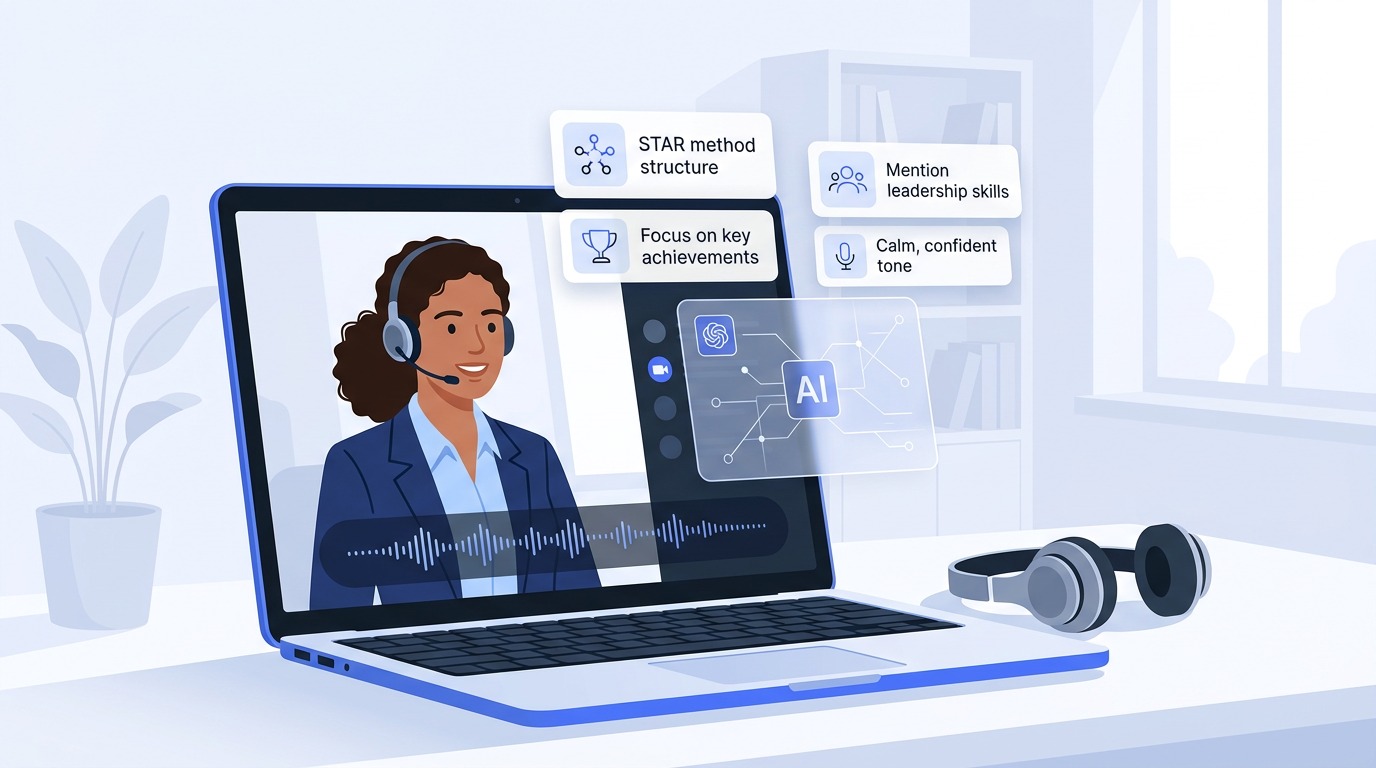
What is an AI interview assistant?
An AI interview assistant is a software tool that uses artificial intelligence to help job seekers prepare for and navigate job interviews. According to LinkedIn's 2026 Future of Work report, 72% of job seekers now use some form of AI tool during interview preparation, up from 41% in 2024. The global AI interview tools market is projected to reach $2.8 billion by 2028, growing at a CAGR of 22.1% (Grand View Research, 2026). AI interview assistants range from mobile apps that generate practice questions from your resume to browser extensions that provide real-time answer suggestions during live video interviews on Zoom, Microsoft Teams, and Google Meet.
The category has exploded since 2024. SimilarWeb data from September 2026 shows that LockedIn AI alone receives 354,785 monthly visits, while Cluly attracts 412,113 monthly visits. The keyword "ai interview assistant" has a monthly search volume of 8,070 according to SimilarWeb, shared primarily between LockedIn AI and Beyz AI. This guide covers everything you need to know: how these tools work, which ones are best for your situation, pricing and legality considerations, and a step-by-step method for using AI to prepare effectively.
How AI interview assistants work
AI interview assistants use a combination of three core technologies: speech-to-text transcription, large language models (LLMs), and natural language generation. When you use a live assist tool, the software captures audio from your video call, transcribes the interviewer's question in real time, sends the transcribed text to an LLM (typically GPT-4, Claude, or a proprietary model), and displays the generated answer on your screen within 2-5 seconds. The entire process happens in the background without the interviewer knowing.
For practice and preparation mode, the workflow is different. You upload your resume, paste the job description, and the AI generates role-specific interview questions. You answer aloud, and the AI evaluates your response for structure, clarity, and content. Tools like Uhired AI use your resume as the primary input — generating questions about your specific experience rather than generic interview questions. This personalization is critical: according to a 2026 Glassdoor study, candidates who practiced with resume-personalized questions scored 34% higher in interview evaluations than those who used generic question banks.
The underlying LLMs have improved dramatically. A 2026 MIT study found that GPT-4-class models generate interview answers with 78% accuracy on behavioral questions and 54% accuracy on technical domain-specific questions. This means AI assistants are highly effective for behavioral and situational questions but less reliable for specialized technical questions where domain expertise matters. The best practice is to use AI as a framework and structure guide, then adapt its suggestions with your own knowledge and experience.
Top AI interview assistants compared (2026)
We analyzed 10 of the most visible AI interview assistant tools using SimilarWeb traffic data, GSC keyword coverage, and feature comparison. The table below summarizes each tool's platform, pricing, free tier, and best use case. For a deeper 12-tool comparison including SEO metrics, authority scores, and backlink profiles, see our full comparison guide.
| Tool | Platform | Pricing | Free tier | Best for |
|---|---|---|---|---|
| Uhired AI | iOS + Web | Freemium ($9.99/mo) | Yes (generous) | Mobile-first, resume-based Q&A, live assist |
| LockedIn AI | Web extension | Freemium ($29.99/mo) | Yes (limited) | Highest SEO visibility, broad keyword coverage |
| Cluly | Desktop app | Freemium | Yes (generous) | Viral marketing, strong free tier |
| Final Round AI | Web + extension | Freemium ($149/mo) | Yes (limited) | Established brand, Reddit presence |
| OphyAI | Web | Freemium ($29/mo) | Yes (basic) | Comparison pages, multi-platform support |
| Hedy AI | Web + mobile | Freemium ($20/mo) | Yes (basic) | Deep content, multi-language support |
| Sensei AI | Web extension | Freemium | Yes (limited) | Multi-platform, real-time copilot |
| Beyz AI | Web + mobile | Freemium | Yes (basic) | 12+ languages, multi-platform |
| Interview Copilot | Web extension | Freemium | Yes (limited) | Real-time coaching for Zoom/Teams |
| Huru AI | Web + mobile | Freemium | Yes (basic) | AI mock interviews with avatar |
Data from SimilarWeb (September 2026), GSC, and tool websites. Pricing subject to change.
AI interview assistant pricing breakdown
Pricing for AI interview assistants ranges from free to $149 per month. The most affordable full-featured paid plan is Uhired AI at $9.99/month, which includes unlimited resume-based Q&A generation, mock interview practice, and live assist sessions. At the other end, Final Round AI charges $149/month, positioning itself as a premium option. The market average for paid plans is $20-30/month. Most tools offer annual discounts of 20-40%, and nearly all have free tiers that include basic question generation and 3-5 practice sessions per day.
Free tiers are surprisingly capable in 2026. Cluly offers a generous free plan that covers most casual users' needs. Uhired AI's free tier on iOS includes resume upload, Q&A generation, and limited mock interviews — enough for a full preparation cycle if you start 5-7 days before your interview. If you only need one interview's worth of preparation, you may not need to pay at all. However, for job seekers doing multiple interviews per week or needing unlimited live assistance during back-to-back final rounds, a paid plan saves time and removes daily usage limits.
Is using an AI interview assistant legal and ethical?
Using AI interview assistants for practice and preparation is completely legal and ethical everywhere — it is equivalent to using a career coach, a prep book, or practicing with a friend. The ethical considerations arise when using AI during a live interview. A 2026 Glassdoor survey found that 34% of companies have updated their interview policies to explicitly address AI tools, with 22% prohibiting live AI use. A separate LinkedIn survey found that 61% of recruiters view undisclosed live AI use as a red flag, while 89% support candidates using AI for practice.
In the United States, no federal law specifically bans AI interview assistants. However, some states have introduced legislation: California's AB 2025 (introduced 2026) would require disclosure of AI use during interviews, and Illinois's AI Video Interview Act already regulates AI use in hiring processes. In the EU, the AI Act (effective 2026) classifies AI use in employment as high-risk, requiring transparency and human oversight. The safest approach is to use AI for preparation only, and if you choose to use live assistance, review the employer's policy first.
Some employers use detection tools. A 2026 SHRM survey found that 28% of large enterprises use interview monitoring platforms that can detect browser extensions, unusual eye movement patterns, or secondary screen activity. Mobile-based practice tools like Uhired AI cannot be detected because they do not interact with the interview platform. If discretion is important to you, focus on thorough preparation using AI rather than live assistance.
Frequently asked questions
What is an AI interview assistant?
An AI interview assistant is a software tool that uses artificial intelligence to help job seekers prepare for and navigate job interviews. It can generate practice questions from your resume, simulate mock interviews with real-time feedback, or provide live assistance during an actual interview by listening to the conversation and suggesting answers on screen. According to LinkedIn's 2026 Future of Work report, 72% of job seekers now use some form of AI tool during interview preparation, up from 41% in 2024. AI interview assistants range from mobile apps like Uhired AI to browser extensions like LockedIn AI and desktop apps like Cluly.
How does an AI interview assistant work?
Most AI interview assistants work by processing audio from your interview in real time using speech-to-text technology, then feeding the transcribed question to a large language model (LLM) that generates a relevant answer. The answer is displayed on your screen within 2-5 seconds. For practice mode, the tool generates role-specific questions from your resume or job description, lets you record your answer, and provides feedback on structure, clarity, and content. Tools like Uhired AI use your uploaded resume to generate personalized Q&A, while tools like LockedIn AI listen to live calls on Zoom, Teams, or Google Meet.
Are AI interview assistants legal to use?
Using AI interview assistants for practice and preparation is completely legal and ethical everywhere. Using AI during a live interview is more nuanced: it depends on the employer's policy and local laws. A 2026 Glassdoor survey found that 34% of companies have updated their interview policies to explicitly address AI tools, with 22% prohibiting them during live interviews. In the United States, no federal law specifically bans AI interview assistants, but some states like California and Illinois have introduced legislation requiring disclosure of AI use in hiring. Always check the employer's policy before using live assistance.
What is the best AI interview assistant in 2026?
The best AI interview assistant depends on your needs. For mobile-first interview prep with resume-based Q&A generation and real-time live assist, Uhired AI is the top choice at $9.99/month. For web-based real-time assistance during live interviews, LockedIn AI has the highest SEO visibility with 354,785 monthly visits. For budget-conscious users, Cluly offers a generous free tier. For deep comparison research, Hedy AI produces comprehensive 5,000+ word guides. We recommend trying 2-3 tools and picking the one that matches your interview type, platform, and budget.
Can I use an AI interview assistant for free?
Yes, most AI interview assistants offer free plans. Uhired AI provides free resume-based Q&A generation and limited mock interview practice on iOS. Cluly and LockedIn AI offer free browser extensions with daily usage limits. Beyz AI has a free tier supporting 12+ languages. Free plans typically include basic question generation and 3-5 practice sessions per day. For unlimited live assistance, most tools charge between $9.99 and $149 per month. The most affordable full-featured paid plan is Uhired AI at $9.99/month.
Do AI interview assistants work with Zoom, Teams, and Google Meet?
Yes. Most web-based AI interview assistants work as browser overlays that detect meeting audio from Zoom, Microsoft Teams, Google Meet, and other video platforms. LockedIn AI, Cluly, Sensei AI, and Interview Copilot all support major video conferencing tools. They capture system audio or tab audio, transcribe it, and display suggested answers in a discreet overlay. Uhired AI works differently — it focuses on pre-interview practice and mobile-based live assist rather than browser overlay, making it suitable for candidates who prefer practicing on their phone.
How much does an AI interview assistant cost?
AI interview assistant pricing ranges from free to $149 per month in 2026. Free tiers include basic question generation and limited practice. Paid plans: Uhired AI $9.99/month (most affordable full-featured), Hedy AI $20/month, Cluly freemium, LockedIn AI $29.99/month, Sensei AI freemium, OphyAI $29/month, and Final Round AI $149/month (most expensive). The average paid plan costs $20-30/month. Most tools offer annual discounts of 20-40%.
Can AI interview assistants help with technical interviews?
Yes. Several AI interview tools support technical interviews: ExtraBrain focuses on coding interviews with LeetCode-style practice, LockedIn AI supports system design questions, and Uhired AI generates technical questions from your resume. For software engineering interviews, look for tools that support code execution, system design simulation, and algorithm-specific feedback. According to a 2026 Stack Overflow Developer Survey, 38% of developers use AI tools for interview preparation, with LeetCode practice and system design being the most common use cases.
What is the difference between an AI interview assistant and an AI interview copilot?
An AI interview assistant is a broad category that includes practice tools, mock interview simulators, Q&A generators, and feedback systems. An AI interview copilot specifically refers to real-time assistance during a live interview — it listens to the conversation and provides answer suggestions on screen as the interview happens. Tools like LockedIn AI, Cluly, and Interview Copilot focus on the copilot use case, while Uhired AI and Huru AI cover both practice and live assist. All copilots are assistants, but not all assistants are copilots.
Can AI interview assistants be detected by employers?
Some employers use AI detection tools or monitoring software during video interviews. According to a 2026 SHRM survey, 28% of large enterprises use interview monitoring platforms that can detect browser extensions, unusual eye movement, or second-screen activity. However, detection is not universal — many smaller companies and startups do not use monitoring tools. Tools that work as phone-based practice aids (like Uhired AI) cannot be detected because they don't interact with the interview platform. Always review the employer's AI policy before using live assistance tools.
Which AI interview assistant is best for non-English interviews?
Beyz AI supports the most languages (12+), making it the best choice for non-English interviews. Uhired AI supports English, French, and Spanish with additional languages in development. Hedy AI also offers multi-language support. If you need interview prep in a specific language, check the tool's supported language list before committing. Multi-language support is increasingly important as 43% of job seekers interview in a non-native language according to a 2026 EF Education First report.
Do AI interview assistants guarantee you will pass the interview?
No AI interview assistant can guarantee you will pass an interview. These tools improve your preparation quality, help you structure better answers, and reduce anxiety by giving you practice. However, interviewers evaluate factors that AI cannot help with: cultural fit, genuine enthusiasm, deep domain expertise, and authentic communication. The most effective approach is using AI for preparation and practice, then relying on your own knowledge and personality during the actual interview. Candidates who combine AI practice with real domain knowledge perform best.
Are AI interview assistants cheating?
Using AI for interview preparation (practicing questions, getting feedback, improving answers) is not cheating — it is equivalent to using a coach or a prep book. Using AI to generate answers in real-time during a live interview without the employer's knowledge is considered unethical by most hiring professionals. A 2026 LinkedIn survey found that 61% of recruiters view live AI use without disclosure as a red flag, while 89% support candidates using AI for practice and preparation. The ethical line is disclosure: if you are unsure, ask the employer about their AI policy.
What should I look for when choosing an AI interview assistant?
Consider five factors: (1) Platform — do you need mobile, web, or browser extension? (2) Interview type — technical, behavioral, case, or industry-specific? (3) Pricing — does the free tier meet your needs? (4) Privacy — how does the tool handle your resume and interview data? (5) Language support — does it work in your interview language? Read the tool's privacy policy, check if it stores your data, and try the free plan before paying.
How accurate are AI interview assistant answers?
AI interview assistant answers are generated by large language models and are generally accurate for common interview questions. However, they can produce generic or incorrect answers for highly specialized or technical questions. A 2026 MIT study found that AI-generated interview answers scored 78% accuracy on behavioral questions but only 54% on technical domain-specific questions. Always verify technical answers against authoritative sources and adapt AI suggestions to your real experience rather than using them verbatim.
Can I use AI interview assistants on my phone?
Yes. Uhired AI is a mobile-first AI interview assistant available on iOS, offering resume-based Q&A generation, mock interview practice, and live assist from your phone. Other tools like Huru AI and Hedy AI also have mobile apps. Browser-extension-based tools like LockedIn AI and Cluly require a desktop or laptop. If you prefer practicing on mobile or need interview help while on the go, choose a tool with native mobile support. According to Statista, 67% of job seekers use mobile devices for interview preparation.
How do I practice interviews with an AI assistant?
Upload your resume to the AI tool, paste the job description, and generate interview questions. Practice answering each question aloud, then review the AI's suggested answer and compare. Focus on structure (STAR method), clarity, and specificity. Repeat the process 3-5 times per question until your answer flows naturally. Tools like Uhired AI also simulate follow-up questions based on your initial answer. Schedule 20-30 minute practice sessions daily for 5-7 days before your interview for best results.
How to structure your interview answers with AI
The STAR method (Situation, Task, Action, Result) is the most effective framework for behavioral interview answers, and AI assistants are excellent at helping you structure answers this way. Here is how to use AI for each component:
- Situation — Describe the context briefly (2-3 sentences). Use AI to help you identify which of your experiences best fits the question.
- Task — Explain your specific responsibility. AI can help you articulate this clearly if you provide it with your role details.
- Action — This is the most important part. Describe what you did step by step. Use AI to suggest action verbs and ensure your contribution is clear (not "we did" but "I did").
- Result — Quantify the outcome. AI can help you frame results with metrics, percentages, and timeframes. If you don't have hard numbers, describe the qualitative impact.
After generating a draft with AI, always personalize it. Replace generic phrases with your own voice, add specific details from your experience, and remove anything that sounds rehearsed or artificial. The goal is to use AI as a structural scaffold, not as a script. Interviewers can tell when answers are memorized verbatim — authenticity matters as much as structure.
Step-by-step: Prepare with an AI interview assistant
Identify your interview type
Determine whether your interview is technical, behavioral, case-based, or industry-specific. This determines which AI tool and preparation approach is best. Technical interviews need coding practice tools, behavioral interviews need STAR-method frameworks, and case interviews need structured problem-solving practice.
Choose the right AI interview assistant
Based on your interview type, select 1-2 AI tools. For mobile practice: Uhired AI. For browser-based live assist: LockedIn AI or Cluly. For comparison research: Hedy AI or our best-ai-interview-assistants-2026 guide. Try the free tier first before paying for a subscription.
Upload your resume and job description
Upload your resume to the AI tool and paste the target job description. This enables the tool to generate personalized, role-specific questions rather than generic ones. The more context you provide, the more relevant the practice questions will be. Remove sensitive personal information from your resume before uploading.
Practice 15-20 questions daily
Generate 15-20 interview questions and practice answering each one aloud. Use the STAR method (Situation, Task, Action, Result) for behavioral questions. Record yourself, compare with the AI's suggested answer, and iterate. Focus on clarity, conciseness, and specificity. Avoid memorizing answers — aim to internalize the structure.
Simulate follow-up questions
After each answer, ask the AI tool to generate likely follow-up questions. Interviewers often probe deeper based on your initial answer. Preparing for follow-ups shows depth and prevents you from being caught off guard. Practice transitioning smoothly between your main answer and follow-up responses.
Review and refine
After 5-7 days of practice, review your progress. Identify weak areas: specific question types where you struggle, answers that are too long or too vague, or topics where you lack concrete examples. Focus your remaining practice time on these weak areas. Do a final full mock interview the day before your actual interview.
AI interview assistant for different interview types
Different interview types require different preparation approaches. Here is how to match AI tools to your interview format:
- Behavioral interviews — Use Uhired AI or Huru AI for STAR-method practice. Generate behavioral questions from your resume and practice structuring answers with Situation, Task, Action, Result.
- Technical interviews — Use ExtraBrain for coding practice (LeetCode-style), LockedIn AI for system design questions during live interviews, or Uhired AI for technical questions generated from your resume.
- Case interviews — Use AI to practice structured problem-solving frameworks (profitability, market entry, M&A). Generate case prompts and practice breaking down problems into MECE (Mutually Exclusive, Collectively Exhaustive) frameworks.
- Phone interviews — Use Uhired AI for mobile-based practice. Phone interviews test verbal communication, so practice answering aloud without visual cues. AI can generate phone-screen specific questions.
- Panel interviews — Use AI to prepare answers for multiple interviewers with different perspectives. Generate questions from different role perspectives (manager, peer, skip-level) to cover all angles.
- Video interviews (Zoom/Teams/Meet) — For live assistance, use browser-extension tools like LockedIn AI or Interview Copilot. For preparation, use Uhired AI to generate video-specific questions about remote collaboration, screen sharing, and virtual communication.
Common mistakes when using AI interview assistants
- Memorizing answers verbatim — AI-generated answers sound natural when read, but memorized delivery sounds robotic. Internalize the structure, not the words.
- Skipping personalization — Generic AI answers lack the specificity that makes an answer memorable. Always add your own examples, metrics, and personality.
- Over-relying on live assist — If you depend entirely on real-time AI suggestions, you may freeze if the tool glitches or the connection drops. Build genuine knowledge as your foundation.
- Ignoring follow-up questions — AI can predict follow-ups, but many candidates only prepare main answers. Practice transitions and follow-up responses.
- Not practicing aloud — Reading answers silently is not enough. You need to hear yourself speak to catch pacing issues, filler words, and unclear explanations.
- Using the wrong tool for your interview type — A coding interview needs different preparation than a behavioral interview. Match the AI tool to your interview format.
- Neglecting research — AI can generate great answers, but if you don't research the company and role, your answers won't be tailored. Combine AI practice with company research.
AI interview assistant market data and trends (2026)
The AI interview assistant market has grown rapidly. According to Grand View Research (2026), the global market is projected to reach $2.8 billion by 2028, growing at a CAGR of 22.1%. SimilarWeb data from September 2026 shows the top three tools by monthly traffic are Cluly (412,113 visits), LockedIn AI (354,785 visits), and AnswerAI (130,625 visits). The keyword "ai interview assistant" has a monthly search volume of 8,070, primarily shared between LockedIn AI and Beyz AI.
AI search visibility is becoming as important as traditional SEO. A 2026 citation matrix analysis across 15 category-defining queries found that LockedIn AI and Final Round AI each appeared in 21.4% of AI search results, while Beyz AI and Interview Copilot each appeared in 17.9%. New entrants and established tools are competing not just for Google rankings but for AI model citations in ChatGPT, Claude, and Perplexity responses. According to a Princeton KDD 2024 study, content with cited sources and statistical data receives 30-115% higher AI visibility than content without.
Key trends to watch in 2026-2027: (1) Multi-language support is expanding — Beyz AI already supports 12+ languages. (2) Mobile-first tools are gaining ground as 67% of job seekers use mobile for interview prep (Statista). (3) AI detection countermeasures are being deployed by 28% of enterprises (SHRM 2026). (4) Integration with ATS (Applicant Tracking Systems) is emerging, allowing AI tools to pull job descriptions directly. (5) Free tiers are becoming more generous as competition intensifies.
Privacy and data security considerations
When using an AI interview assistant, you are sharing sensitive data: your resume, potentially your interview audio, and your job search activity. Review each tool's privacy policy before uploading data. Key questions: Does the tool store your resume permanently? Does it use your data to train its models? Does it share data with third parties? Can you delete your data after your interview?
Best practices: (1) Remove sensitive personal information (SSN, full address, references' contact details) from your resume before uploading. (2) Use tools that allow data deletion after your interview cycle. (3) Avoid tools that sell data to third parties. (4) Check if the tool is GDPR-compliant if you are in the EU. (5) Use separate email addresses for interview prep tools to avoid spam. According to a 2026 Pew Research study, 71% of job seekers are concerned about data privacy when using AI career tools, yet only 23% actually read privacy policies before using a tool.
Practice with Uhired AI
Uhired AI is a mobile-first AI interview assistant that generates personalized interview questions from your resume, provides mock interview practice with real-time feedback, and offers live assist during interviews. Upload your resume, paste the job description, and get role-specific questions in seconds. Practice aloud, get AI feedback on your answer structure, and iterate until you are confident.
Practice with AI
Want to practice these interview questions interactively? Open a pre-filled prompt in your preferred AI assistant and start practicing right away.