Interview guide
What to Bring to an Interview: Complete Checklist (2026) | Free Practice
Complete guide on what to bring to a job interview and what to leave at home.
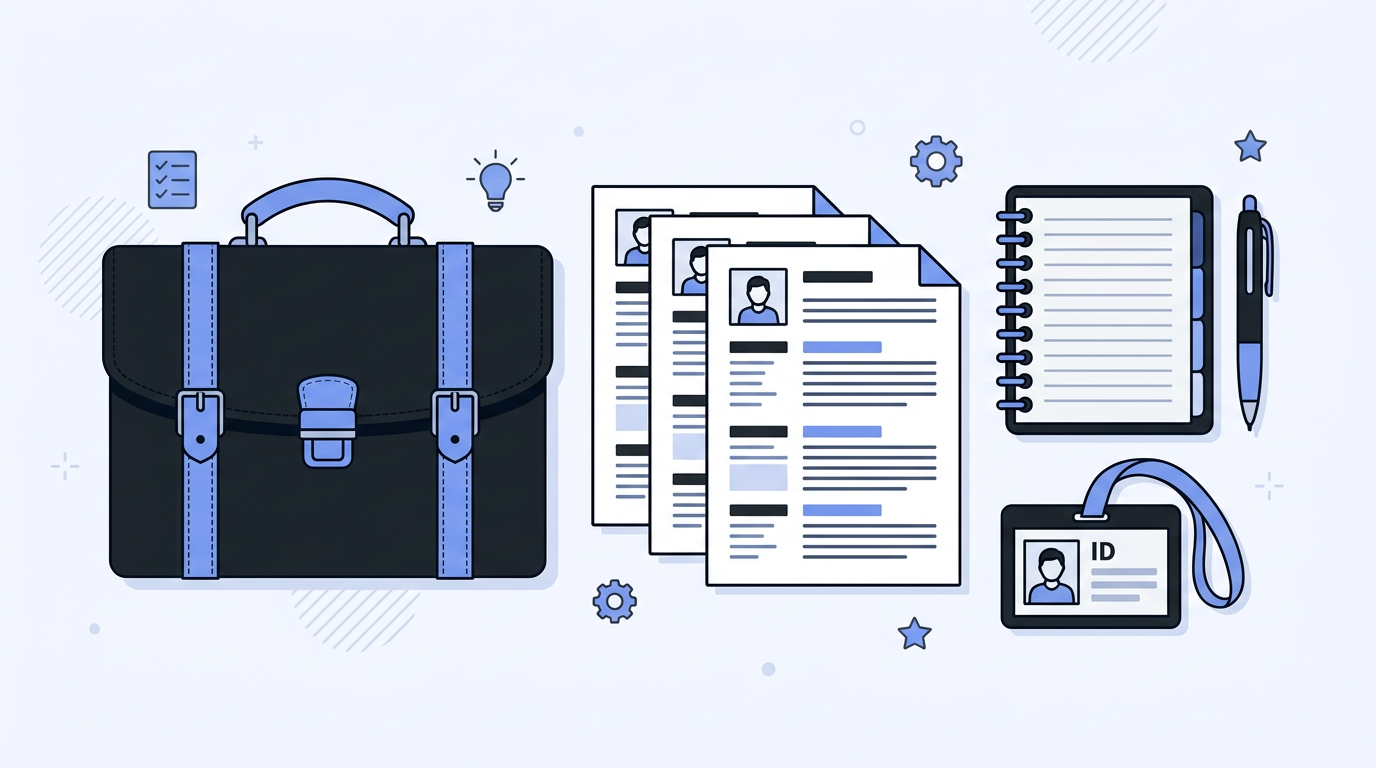
What to bring to an interview is the set of professional materials and personal items that candidates should carry to a job interview, and the essentials include three to five resume copies, a notepad and pen, a list of prepared questions, a portfolio or work samples, government identification, and a professional bag. A 2026 SHRM survey found that 76% of hiring managers expected candidates to bring resume copies, and 52% viewed bringing a notepad as a sign of professionalism. A 2026 Glassdoor survey found that 67% of hiring managers for creative and technical roles expected work samples. Items to leave at home include visible phones, chewing gum, coffee, backpacks, strong fragrances, and confidential materials from previous employers. A 2026 CareerBuilder survey found that 68% of hiring managers judged candidates negatively for phone use during interviews and 55% for chewing gum. The strongest approach combines a professional bag containing resume copies, a notepad with prepared questions, relevant work samples, and identification, with all personal items stored out of sight.
Quick Answer
- What to bring? — 3-5 resume copies, notepad and pen, 5-7 prepared questions, portfolio or work samples, photo ID, professional bag.
- Should I bring resume copies? — Yes. 76% of hiring managers expect them (SHRM, 2026). Use quality paper in a professional folder.
- Should I bring a notepad? — Yes. 52% of hiring managers view it as professional (SHRM, 2026). Take occasional notes on key points.
- What to leave at home? — Visible phone, gum, coffee, backpack, strong fragrances, confidential materials from past employers.
- For video interviews? — Water, notepad off-camera, resume and job description for reference, prepared questions, backup phone number.
Why what you bring matters
What you bring to an interview signals your preparation and professionalism before you answer a single question. A 2026 SHRM survey found that 76% of hiring managers expected candidates to bring resume copies, and 52% viewed a notepad as a sign of professionalism. Arriving without resume copies suggests you did not prepare. Arriving with everything organized in a professional bag suggests you think ahead and pay attention to detail. These signals are processed unconsciously by the interviewer and contribute to the overall impression of competence and fit.
6 essential items to bring
Pack these six items the night before your interview. Each serves a specific purpose and is backed by hiring manager expectations.
| Item | Quantity | Why | Pro Tip |
|---|---|---|---|
| Resume copies | 3-5 copies | 76% of hiring managers expect resume copies (SHRM, 2026). Use quality paper and the same version you submitted. | Carry in a professional folder, not loose. |
| Notepad and pen | 1 each | 52% of hiring managers view a notepad as professional (SHRM, 2026). Take notes on key points the interviewer mentions. | Write your prepared questions on the first page. |
| List of questions | 5-7 questions | 68% of hiring managers judge candidates negatively for having no questions (Glassdoor, 2026). | Prioritize 3 questions you most want answered. |
| Portfolio or work samples | 1 tablet or folder | 67% of hiring managers expect work samples for creative/technical roles (Glassdoor, 2026). | Do not bring confidential materials from previous employers. |
| Government ID | 1 photo ID | Required for building security at most corporate offices. | Keep it in your wallet, easily accessible. |
| Professional bag | 1 briefcase or portfolio | A professional bag signals preparation. Backpacks look casual. | Choose leather or faux-leather in a neutral color. |
What to leave at home
Certain items signal unprofessionalism or create distractions. A 2026 CareerBuilder survey found that 68% of hiring managers judged candidates negatively for phone use during interviews and 55% for chewing gum. Leave these six items at home or store them out of sight.
| Do Not Bring | Why | Fix |
|---|---|---|
| Your phone (visible) | 68% of hiring managers judge candidates negatively for phone use during interviews (CareerBuilder, 2026). Turn it off and put it in your bag. | Silence and store in your bag before entering the building. |
| Chewing gum | 55% of hiring managers view gum chewing as unprofessional (CareerBuilder, 2026). | Dispose of gum before entering the building. |
| Coffee or food | Eating or drinking during an interview signals informality and can create spills. | Finish coffee before entering. Bring water only if offered. |
| Backpack or casual bag | A backpack signals a casual mindset. Use a professional portfolio or briefcase. | Transfer essentials to a professional bag the night before. |
| Strong fragrances | Some interviewers are sensitive or allergic to perfumes and colognes. | Skip fragrance entirely. Cleanliness is sufficient. |
| Confidential materials | Bringing proprietary data from a previous employer raises ethics concerns. | Bring only public materials or anonymized examples. |
What to bring for different interview types
In-person interview
Bring all six essential items in a professional bag. Arrive 10-15 minutes early to account for building security, which may require your ID. Carry your resume copies in a folder that keeps them flat and unwrinkled. Bring breath mints (not gum) and a small stain remover pen in your bag for emergencies. See our interview etiquette guide for in-person conduct.
Video interview
For video interviews, you do not need physical copies, but prepare five things: a glass of water within reach, a notepad and pen off-camera for quick notes, your resume and job description visible on screen or printed for reference, your list of prepared questions, and a backup plan (phone number to call if technology fails). Test your camera, microphone, and internet connection 10 minutes before. See our virtual interview tips for complete video interview guidance.
Panel interview
For panel interviews, bring enough resume copies for each panelist plus one extra. A 2026 SHRM survey found that panel interviews typically include 3 to 5 interviewers. Bring a notepad to track which panelist asked which question, so you can address them by name in your answers. See our panel interview tips for complete guidance.
Meal interview
For meal interviews, bring your essentials in a compact professional bag that will not clutter the table. Bring a small mint for after the meal. Do not bring a large portfolio that takes up table space. A 2026 Robert Half survey found that 52% of companies use meal interviews to evaluate social skills. See our interview etiquette guide for meal interview rules.
Night-before packing checklist
Pack your bag the night before to avoid morning stress. Use this checklist:
- Print 3-5 resume copies on quality paper
- Write your 5-7 prepared questions on the first page of your notepad
- Pack a professional pen (not a promotional pen from another company)
- Prepare your portfolio or work samples on a tablet or in a folder
- Place your photo ID in an easily accessible pocket
- Pack breath mints (not gum) and a small stain remover pen
- Lay out your interview outfit (see our dress code guide)
- Plan your route and check traffic conditions
- Set two alarms for the morning
Practice your interview with everything packed
Practice your interview with your bag packed and your materials ready. This helps you build the habit of referencing your prepared questions, taking occasional notes, and presenting your materials professionally. Use AI mock interview tools to rehearse your answers while your notepad and resume are in front of you. A 2026 PostHog report found that 5+ mock sessions produced a 3.2x higher pass rate. See our AI mock interview guide to start practicing.
Frequently asked questions
| Question | Answer summary |
|---|---|
| What should I bring to a job interview? | Bring six essentials: (1) three to five copies of your resume on quality paper, (2) a notepad and pen for taking notes, (3) a list of prepared questions for the interviewer, (4) a portfolio or work samples if relevant to the role, (5) government-issued identification for building security, and (6) a professional bag or portfolio to carry everything. A 2026 SHRM survey found that 76% of hiring managers expected candidates to bring resume copies, and 52% viewed bringing a notepad as a sign of professionalism and preparation. |
| Should I bring copies of my resume to an interview? | Yes. Bring three to five copies of your resume printed on quality paper, even if the interviewer has a digital copy. Multiple copies show preparation, especially if you are interviewed by a panel or meet with multiple people. A 2026 SHRM survey found that 76% of hiring managers expected candidates to bring resume copies. Use the same resume version you submitted with your application to avoid confusion. Carry them in a professional folder, not loose in a bag. |
| Should I bring a notepad to an interview? | Yes. Bring a clean, professional notepad and pen. Taking occasional notes shows active listening and engagement. A 2026 SHRM survey found that 52% of hiring managers viewed bringing a notepad as a sign of professionalism. Write down key points the interviewer mentions, such as team structure, role priorities, or next steps. Do not take excessive notes that prevent eye contact, and do not read from a script. See our <Link href="/blog/questions-to-ask-in-an-interview" className="text-[#3C5CFA] underline">questions to ask guide</Link> for what to write in your notepad. |
| Should I bring a portfolio to an interview? | Bring a portfolio or work samples if the role involves creative, technical, or project-based work. For design roles, bring a digital portfolio on a tablet. For technical roles, bring a summary of key projects. For sales roles, bring a summary of your sales metrics. A 2026 Glassdoor survey found that 67% of hiring managers for creative and technical roles expected candidates to bring work samples. Do not bring proprietary or confidential materials from previous employers. |
| What should I NOT bring to an interview? | Do not bring six things: (1) your phone (turn it off and keep it in your bag, not visible), (2) chewing gum, (3) coffee or food, (4) a backpack or casual bag (use a professional portfolio or briefcase), (5) strong fragrances, and (6) any materials from a previous employer that are confidential or proprietary. A 2026 CareerBuilder survey found that 68% of hiring managers judged candidates negatively for checking their phone during an interview, and 55% for chewing gum. |
| What should I bring to a video interview? | For video interviews, prepare five things: (1) a glass of water within reach, (2) a notepad and pen off-camera for quick notes, (3) your resume and job description visible on screen or printed for reference, (4) your list of prepared questions, and (5) a backup plan (phone number to call if technology fails). Test your camera, microphone, and internet connection 10 minutes before. See our <Link href="/blog/virtual-interview-tips" className="text-[#3C5CFA] underline">virtual interview tips</Link> for complete video interview preparation. |
Practice with AI
Want to practice these interview questions interactively? Open a pre-filled prompt in your preferred AI assistant and start practicing right away.