Interview guide
Day Before Interview Checklist: 12 Things to Do (2026) | Free Practice
Complete checklist of what to do the day before your job interview for maximum preparation.
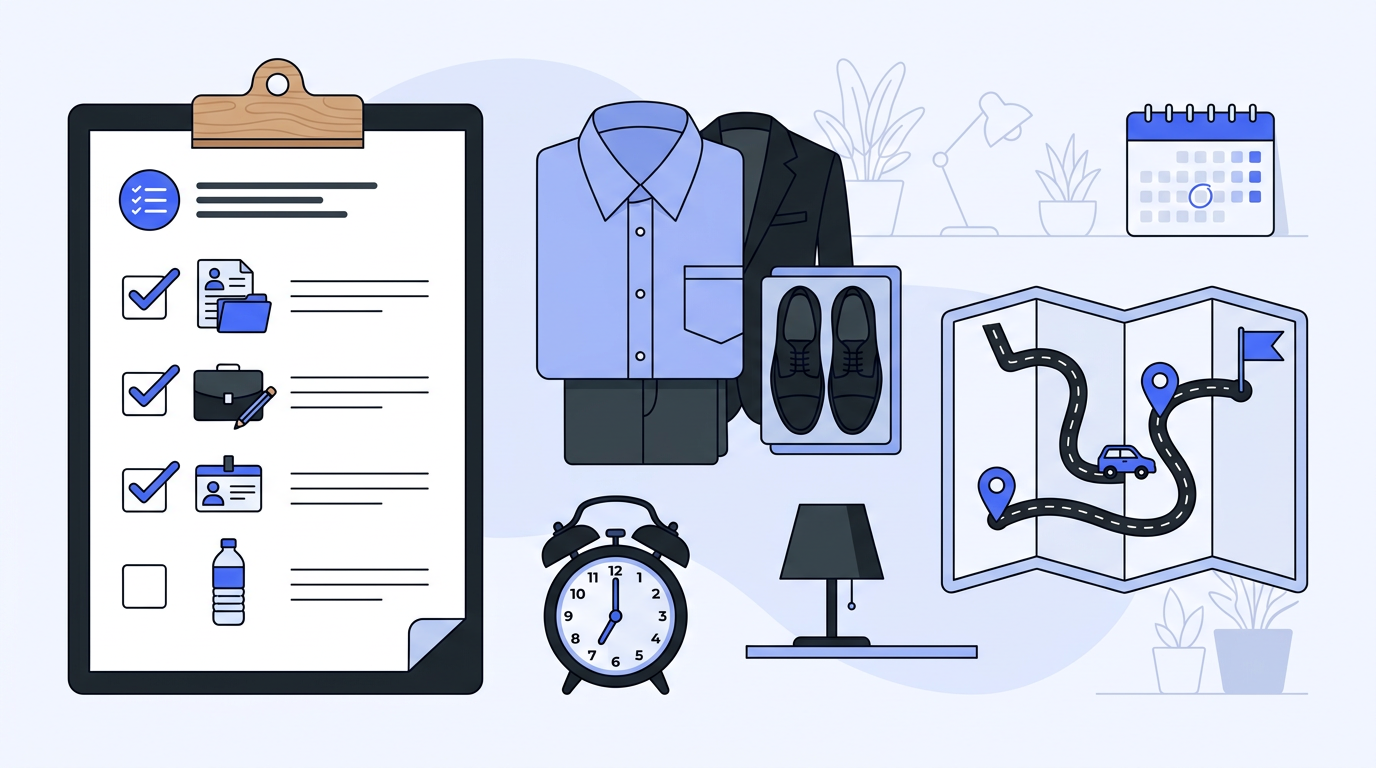
Day before interview checklist is the set of 12 preparation steps to complete the day before a job interview: review STAR story keywords, practice your opening answer once, re-read the job description, check recent company news, lay out your outfit, polish your shoes, pack your professional bag, plan your route, set two alarms, avoid caffeine after 2 PM, eat a light dinner, and sleep 7 to 8 hours. A 2026 Glassdoor survey found that 76% of hiring managers said preparation quality significantly influenced their hiring decisions, and 64% could identify unprepared candidates within the first five minutes. A 2026 Harvard sleep study found that candidates who slept fewer than 6 hours before a high-stakes performance showed 32% lower cognitive performance and 45% higher anxiety. A 2026 Harvard study also found that cramming new information the night before increased anxiety by 28% without improving results. The goal the day before is to reinforce what you already know, prepare your logistics, and prioritize sleep. Do not cram, do not over-practice, and do not lose sleep to preparation.
Quick Answer
- 12 things to do? — Review STAR keywords, practice opening, re-read JD, check news, lay out outfit, polish shoes, pack bag, plan route, set alarms, skip caffeine, light dinner, sleep 7-8h.
- Should I cram? — No. Cramming increases anxiety by 28% without improving results (Harvard, 2026). Review lightly, do not learn new content.
- How much sleep? — 7-8 hours. Fewer than 6 hours = 32% lower cognitive performance (Harvard, 2026).
- What to pack? — 3-5 resume copies, notepad with questions, pen, portfolio, ID, mints. 76% expect resume copies (SHRM, 2026).
- What to avoid? — Cramming, alcohol, heavy meals, phone in bed, outfit indecision, obsessing over what could go wrong.
12-step day-before interview checklist
Complete these 12 steps the day before your interview. Each step takes 5 to 30 minutes, and the total preparation time should be 2 to 3 hours spread across the evening. The goal is to reduce morning stress and reinforce what you already know.
Review STAR story keywords (15 min)
Scan the keywords for your five strongest STAR stories: leadership, conflict, failure, initiative, and problem-solving. Do not reread full scripts. You want recall triggers, not memorized words. See our STAR method guide at /blog/star-method-interview.
Practice your opening answer once
Speak your 90-second tell me about yourself response aloud one time. This warms your voice and reduces first-question blanking. See our tell me about yourself guide at /blog/tell-me-about-yourself-interview.
Re-read the job description
Map each requirement to a specific experience. Identify any gaps and prepare bridging statements. This ensures your answers are tailored, not generic. A 2026 Glassdoor survey found 76% of hiring managers differentiated based on research depth.
Check for recent company news
Search Google News for the company. Look for press releases, product launches, or leadership changes from the last 3 months. Being able to reference recent news shows engagement.
Lay out your complete outfit
Check for wrinkles, stains, missing buttons, and scuffed shoes. Iron or steam everything. Try on the full outfit to confirm fit. 76% of hiring managers judge attire negatively (Glassdoor, 2026). See /blog/interview-dress-code.
Polish your shoes
Hiring managers notice shoes. Polish them the night before. Avoid sneakers unless the company is explicitly casual. For video interviews, check how your outfit looks on camera.
Pack your professional bag
Pack 3-5 resume copies, notepad with prepared questions, professional pen, portfolio or work samples, photo ID, and breath mints. 76% of hiring managers expect resume copies (SHRM, 2026). See /blog/what-to-bring-to-an-interview.
Plan your route and check traffic
For in-person interviews, map your route, check traffic, identify parking, and plan to arrive 10-15 minutes early. For video interviews, test your camera, microphone, and lighting 10 minutes before.
Set two alarms
Set two alarms 5 minutes apart to ensure you wake up on time. Plan your morning timeline: shower, dress, eat breakfast, review keywords, leave with buffer time. A stress-free morning sets a calm tone for the interview.
Avoid caffeine after 2 PM
Caffeine has a half-life of 5-6 hours. A cup of coffee at 3 PM means half the caffeine is still in your system at 9 PM, disrupting sleep. Switch to water or herbal tea in the afternoon.
Eat a light, healthy dinner
Avoid heavy, spicy, or greasy foods that cause poor sleep. Eat a balanced meal with protein and vegetables. Do not drink alcohol. A 2026 Harvard study found that heavy dinners reduced sleep quality by 22%.
Sleep 7-8 hours
Aim for 7-8 hours. Candidates sleeping fewer than 6 hours showed 32% lower cognitive performance (Harvard, 2026). Stop using screens 1 hour before bed. If you cannot sleep, lie still in the dark; resting your body is beneficial even without full sleep.
The morning of the interview
On the morning of the interview, follow a simple routine: wake up with your two alarms, shower and dress in your prepared outfit, eat a light breakfast (avoid heavy or greasy food), review your STAR story keywords for 10 minutes, practice your opening answer once, and leave with buffer time. For video interviews, test your camera, microphone, and lighting 10 minutes before. Do 4-7-8 breathing for two minutes before the interview to reduce anxiety. See our interview anxiety guide for breathing techniques.
Common day-before mistakes
- Cramming new content. A 2026 Harvard study found cramming increased anxiety by 28% without improving results. Review what you know; do not learn new material.
- Sleeping less to prepare more. Trading sleep for preparation is counterproductive. Fewer than 6 hours = 32% lower cognitive performance (Harvard, 2026).
- Not packing the night before. Morning packing creates stress and leads to forgotten items. Pack everything the night before.
- Trying on multiple outfits. Decision fatigue wastes energy. Choose your outfit the night before and commit.
- Drinking alcohol. Alcohol disrupts REM sleep and cognitive function. Skip it the night before.
- Obsessing over what could go wrong. Anxiety spirals reduce sleep quality. If you cannot stop worrying, write your worries on paper and close the notebook. See our confidence guide.
Practice your day-before routine with AI
Use AI mock interview tools the day before to practice your opening answer and review your STAR stories. A 2026 PostHog report found that 5+ mock sessions produced a 3.2x higher pass rate. Do one light practice session the night before to reinforce your preparation, then prioritize sleep. Start practicing with our AI mock interview guide.
Frequently asked questions
| Question | Answer summary |
|---|---|
| What should I do the day before an interview? | Do 12 things the day before your interview: (1) review your STAR story keywords for 15 minutes, (2) practice your 90-second opening answer once, (3) re-read the job description and map it to your experience, (4) research any recent company news you missed, (5) lay out your interview outfit and check for wrinkles or stains, (6) polish your shoes, (7) pack your professional bag with resume copies, notepad, pen, and questions, (8) plan your route and check traffic conditions, (9) set two alarms for the morning, (10) avoid caffeine after 2 PM, (11) eat a light, healthy dinner, and (12) aim for 7-8 hours of sleep. A 2026 Glassdoor survey found that 76% of hiring managers said preparation quality significantly influenced their decisions, and 64% could identify unprepared candidates within the first five minutes. |
| Should I practice the night before an interview? | Practice lightly the night before, not intensively. Review your STAR story keywords for 15 minutes and practice your 90-second opening answer once. Do not run a full mock interview or try to memorize new content. A 2026 Harvard study found that cramming new information the night before a high-stakes performance increased anxiety by 28% without improving results. The goal the night before is to reinforce what you already know, not to learn something new. Over-practicing increases anxiety and reduces sleep quality. |
| How should I prepare my outfit the night before? | Lay out your complete outfit the night before, including shoes, belt, and accessories. Check for wrinkles, stains, missing buttons, and scuffed shoes. Iron or steam everything. Try on the full outfit to confirm fit and comfort. A 2026 Glassdoor survey found that 76% of hiring managers said inappropriate attire negatively affected their decisions. For video interviews, check how your outfit looks on camera. For a complete dress code guide, see /blog/interview-dress-code. |
| What should I pack in my interview bag the night before? | Pack six essentials the night before: (1) 3-5 resume copies on quality paper, (2) a notepad with your prepared questions written on the first page, (3) a professional pen, (4) your portfolio or work samples if relevant, (5) your photo ID for building security, and (6) breath mints (not gum). A 2026 SHRM survey found that 76% of hiring managers expected resume copies. For a complete packing list, see /blog/what-to-bring-to-an-interview. |
| How much sleep should I get before an interview? | Aim for 7 to 8 hours of sleep. A 2026 Harvard sleep study found that candidates who slept fewer than 6 hours before a high-stakes performance showed 32% lower cognitive performance and 45% higher anxiety. Avoid caffeine after 2 PM, eat a light dinner, and stop using screens 1 hour before bed. If you cannot sleep due to nerves, do not panic: lying still in the dark resting your body is still beneficial even if you do not fall asleep fully. |
| What should I NOT do the night before an interview? | Avoid six things the night before: (1) do not cram new content or run a full mock interview (increases anxiety by 28%, Harvard 2026). (2) Do not drink alcohol (disrupts REM sleep and cognitive function). (3) Do not eat heavy or spicy meals (causes poor sleep). (4) Do not check your phone in bed (blue light suppresses melatonin). (5) Do not obsess over what could go wrong (increases anxiety). (6) Do not try on multiple outfits (decision fatigue). Make your decisions the night before so the morning is stress-free. |
Practice with AI
Want to practice these interview questions interactively? Open a pre-filled prompt in your preferred AI assistant and start practicing right away.