Interview guide
Warehouse interview questions and answers: a practical prep guide
Use these question patterns and answer structures to prepare for warehouse interviews. Includes 18+ sample answers with STAR-method examples for safety, teamwork, equipment, and reliability.
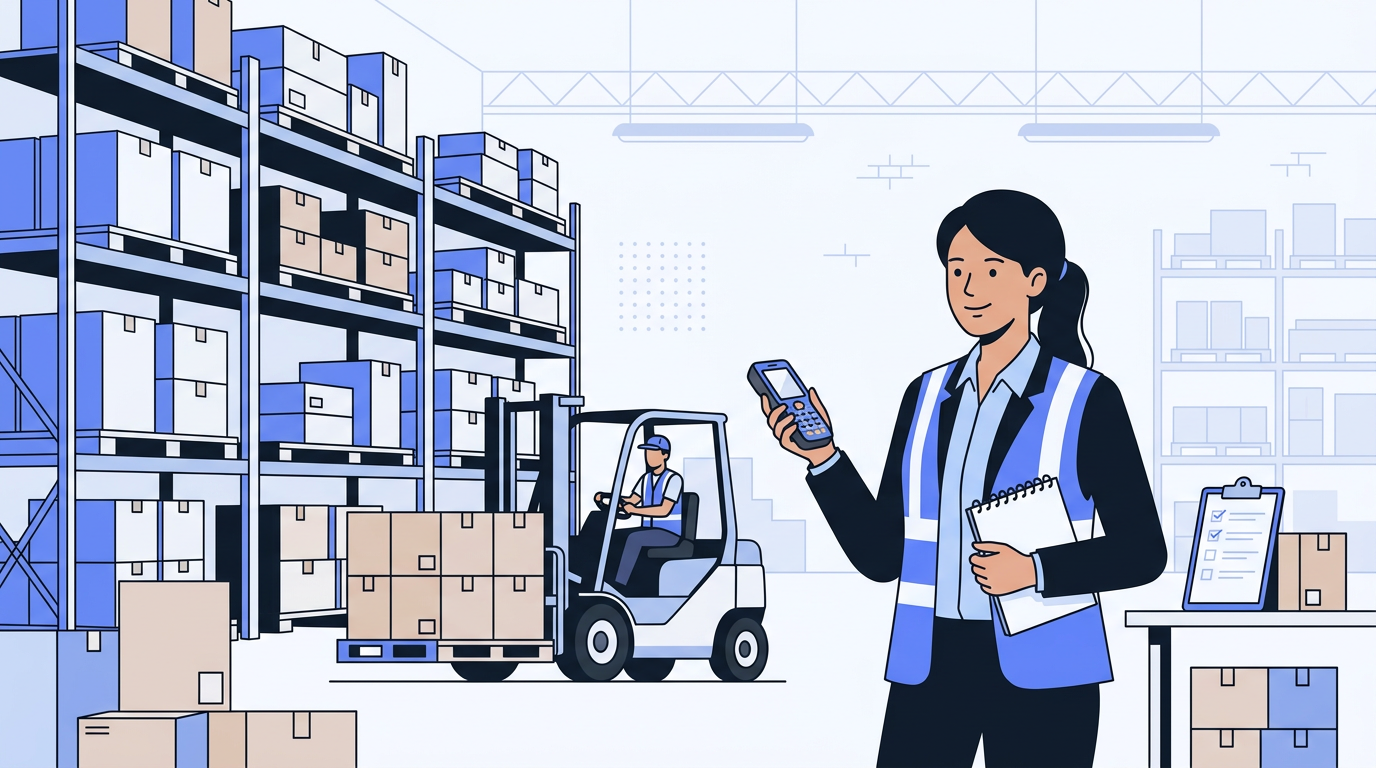
What warehouse interview panels evaluate
Warehouse interviews are practical and direct. The panel is evaluating three things: can you do the physical work safely, will you show up reliably, and will you follow processes without cutting corners. They are not looking for polished corporate talk — they want to know you understand the reality of warehouse work and will not be a safety risk or a reliability problem. Every answer reveals your work ethic, your safety awareness, and your ability to work as part of a team that depends on each other.
Most warehouse interviews include a brief panel interview with 5-8 questions and sometimes a tour of the facility or a brief practical test. Some warehouses require a forklift certification check or a physical capability assessment. The interview is often conversational, not formal — the interviewer wants to see that you are straightforward, safety-conscious, and ready to work. Being genuine and specific about your experience matters more than rehearsed answers.
Common questions and answer frameworks
Below are eighteen of the most frequently asked warehouse interview questions, each with a framework and a sample answer. Adapt the examples to your own experience. For warehouse roles, specificity about safety, equipment, and reliability is what sets candidates apart.
Why do you want to work in a warehouse?
Connect to genuine motivation, not just needing a job. Example: 'I want to work in a warehouse because I enjoy physical work and being part of a team that keeps things moving. In my last role at a distribution center, I found satisfaction in seeing a truck loaded and knowing it was going to reach customers on time. I also appreciate that warehouse work rewards reliability and attention to detail — show up on time, follow the process, and the work speaks for itself.' Avoid saying you just need a job or want any work.
How do you handle the physical demands of warehouse work?
Show you understand the reality and have habits to sustain it. 'I know warehouse work involves standing for long periods, lifting up to 50 pounds, and repetitive movements. I stay fit by exercising regularly and stretching before shifts. I also pay attention to proper lifting technique — bend the knees, not the back — because I know injuries are the biggest risk in this work. I have done physically demanding work before and I know how to pace myself through an 8-hour shift without burning out by lunch.'
Tell me about a time you worked under pressure to meet a deadline.
Use STAR. Situation: We had a truck that arrived 2 hours late, and we still needed to unload and process it before the end of shift. Task: I needed to help the team finish without compromising safety. Action: I suggested we split into two teams — one unloading, one sorting — to parallelize the work. I also communicated with the shift supervisor about the timeline so they knew we were pushing hard. We maintained safety protocols throughout — no shortcuts on lifting or equipment. Result: We finished with 15 minutes to spare, and the truck left on time. I learned that pressure is manageable when you communicate and prioritize safety.'
How do you ensure safety in the warehouse?
Show specific safety practices. 'Safety is not a poster on the wall — it is a daily practice. I wear my PPE at all times: safety vest, steel-toe boots, and gloves. I follow the forklift right-of-way rules and never walk in designated forklift lanes. I inspect equipment before use and report any damage immediately. I also practice proper lifting technique and ask for help with heavy items rather than risking an injury. I have seen coworkers get hurt by rushing, and it is never worth the 30 seconds saved.'
What equipment are you certified to operate?
List honestly with specifics. 'I am certified to operate a forklift (counterbalance and reach truck), a pallet jack (electric and manual), and a order picker. My forklift certification is current and was last renewed 6 months ago. I also have experience with RF scanners for inventory management and have used warehouse management systems like SAP EWM for picking and packing. I learn new equipment quickly — I was trained on the reach truck in one day and was productive by the second shift.'
How do you handle a discrepancy in inventory?
Show attention to detail. 'If I notice a discrepancy — the system says 50 units but I count 47 — I do not ignore it or assume I miscounted. I recount to confirm, then check the receiving and shipping logs to trace where the difference occurred. I report it to my supervisor with all the information I have gathered. I also look for patterns — if the same SKU keeps showing discrepancies, there may be a scanning error or a process gap. Inventory accuracy is everyone responsibility, not just the inventory team.'
Describe a time you had to work with a difficult coworker.
Use STAR. Situation: A coworker was consistently leaving their station messy, which slowed down the next shift. Task: I needed to address it without creating conflict. Action: I approached them during a break and asked if they were aware that the mess was affecting the next shift. They said they did not realize. I suggested we both take 5 minutes at the end of each shift to clean our stations. I started doing it myself and they followed. Result: The station was clean within a week, and the next shift noticed. I learned that most workplace friction comes from lack of awareness, not malice — a conversation solves what a complaint escalates.'
How do you stay focused during repetitive tasks?
Show practical strategies. 'I break the shift into segments — I focus on the next hour, not the whole 8 hours. I set personal targets, like picking a certain number of orders per hour, and try to beat my own record. I also vary my routine when possible — if I am picking, I offer to help with packing or loading to break the monotony. And I remind myself that each order I pick correctly means a customer gets what they ordered on time. Repetition is not boring when you see the purpose behind it.'
What would you do if you noticed a safety violation by another employee?
Show clear priorities. 'Safety comes before everything, including being liked. I would approach the coworker and remind them of the safety rule directly but respectfully — most violations are from habit or forgetting, not recklessness. If they continue, I would report it to a supervisor. I would not ignore it because an unsafe worker endangers everyone, not just themselves. I have seen people skip safety checks because they were in a hurry, and every time it eventually caused an injury or damage. Speaking up is not snitching — it is protecting the team.'
How do you handle a high-volume picking day?
Show a systematic approach. 'On high-volume days, I prioritize by urgency — rush orders first, then standard orders. I plan my route through the warehouse to minimize back-and-forth. I pick in batches when possible to reduce travel time. I also communicate with the packers so they know what is coming and can prepare. If I am falling behind, I tell my supervisor early, not at the end of the shift when it is too late to get help. High-volume days are when you earn your value — the team counts on you to deliver.'
Tell me about a time you improved a process.
Use STAR. Situation: Our picking process required walking back and forth across the warehouse for each order. Task: I wanted to reduce travel time without changing the WMS system. Action: I noticed that orders for similar SKUs were often picked at the same time but in different routes. I suggested grouping orders by zone to the shift supervisor, so pickers stayed in one area instead of crossing the whole warehouse. Result: Travel time per order dropped by 20 percent, and pick rate increased from 80 to 100 orders per hour. I learned that you do not need a new system to improve — sometimes you just need to reorganize how you use the existing one.'
What is your experience with inventory management systems?
Be specific about systems and tasks. 'I have used SAP EWM for 2 years for picking, packing, and inventory confirmation. I also have experience with a handheld RF scanner for cycle counts and location management. I am comfortable printing labels, confirming shipments, and doing putaway. I understand the difference between a cycle count and a full physical inventory, and I know that scanning every item is not optional — it is what keeps the system accurate. I learn new WMS interfaces quickly because the logic is similar across platforms.'
How do you handle working in extreme temperatures?
Show preparation and resilience. 'I know some warehouses have cold storage areas or get very hot in summer. I prepare by dressing appropriately — layers for cold areas, breathable fabric for hot days. I stay hydrated and take my breaks even when I feel fine, because heat exhaustion creeps up. I also communicate with my supervisor if conditions become unsafe — a 100-degree warehouse with no ventilation is not a test of toughness, it is a safety hazard. I have worked in cold storage before and adapted within a week.'
What does teamwork mean to you in a warehouse setting?
Show concrete behaviors. 'Teamwork in a warehouse means your work does not create problems for the next person. It means picking the right items so the packer does not have to resend. It means cleaning your station so the next shift starts clean. It means communicating when you are falling behind so the team can rebalance. It also means helping a coworker who is overwhelmed rather than watching them struggle. A warehouse runs on rhythm — when one person breaks the rhythm, the whole line slows. Teamwork is keeping the rhythm.'
How do you handle a situation where you are given conflicting instructions?
Show problem-solving and communication. 'If two supervisors give me conflicting instructions, I do not pick one and hope. I ask both supervisors to clarify — I explain what the other asked and ask how to reconcile. If they cannot agree, I ask who has final authority on that decision. I never ignore an instruction or assume — in a warehouse, following the wrong instruction can mean shipping the wrong order or creating a safety hazard. Communication takes 30 seconds; guessing can cost hours.'
Tell me about a time you caught an error before it became a problem.
Use STAR. Situation: I was picking an order and the system said to pick 10 units from location A-12, but the label on the shelf said A-21. Task: I needed to verify the correct location before picking. Action: I checked the WMS system again, confirmed the item description matched location A-21, and picked from there. I reported the location mismatch to the inventory team so they could fix it in the system. Result: The customer got the right order, and the system was corrected to prevent future mismatches. I learned that a 2-second check saves a return shipment and a customer complaint.'
Are you available for overtime and different shifts?
Be honest and clear. 'I am available for overtime, especially during peak season. I understand that warehouse work has busy periods — Q4 holidays, back-to-school, inventory time — and the team needs flexibility during those periods. I am also comfortable with shift flexibility, including nights and weekends if needed. I communicate my availability in advance and I do not commit to shifts I cannot work. Reliability means being there when you say you will be, not just when it is convenient.'
Why should we hire you for this warehouse role?
Connect your experience to their needs. Example: 'You should hire me because I combine physical capability with attention to detail. In my last role, I maintained a 99.8 percent picking accuracy rate, operated forklift and reach truck safely for 18 months without an incident, and improved our zone-picking process by 20 percent. I show up on time, I follow safety protocols, and I help my team finish the shift strong. In a warehouse, the best worker is not the fastest — it is the most reliable.'
The STAR method for warehouse behavioral questions
For behavioral questions, use the STAR method. In warehouse interviews, your stories should show safety awareness, teamwork, and problem-solving:
- Situation — What was the warehouse scenario and what was at stake?
- Task — What was your responsibility?
- Action — What did you do? Describe the specific steps, including safety considerations.
- Result — What happened? Quantify it: orders completed, time saved, safety maintained, error caught.
Keep each STAR answer under 90 seconds. In warehouse interviews, brevity signals efficiency — a trait valued in fast-paced operations.
Common mistakes to avoid
- Downplaying safety — Safety is the most important topic. Never say you work fast and skip checks.
- Overestimating physical capabilities — Be honest about lifting limits. Injuries from overestimating are worse than admitting limits.
- Not knowing the equipment — If you say you can operate a forklift, be ready to prove it or show certification.
- Saying you just need a job — Show genuine interest in warehouse work, even if it is a stepping stone.
- Not asking about the shift and schedule — If you do not ask about hours, the interviewer assumes you have not thought about the reality of the work.
Step-by-step interview preparation method
Research the company and warehouse type
Understand the warehouse type — distribution center, fulfillment center, manufacturing warehouse, or cold storage. Know their products, shift schedule, and equipment. Check if they require specific certifications.
Prepare your warehouse stories
Have 5-7 STAR stories: a time you met a tight deadline, a safety issue you caught, a process improvement, a teamwork moment, a high-volume day you handled, and a time you caught an inventory error.
Review safety fundamentals
Know proper lifting technique, PPE requirements, forklift safety rules, and emergency procedures. Safety is the most tested topic in warehouse interviews because it is the biggest risk.
Practice 15 key questions aloud
Use the questions in this guide. Record yourself and listen for reliability, safety awareness, and teamwork. Practice with an AI interview tool for feedback.
Be honest about physical capabilities
If you cannot lift 50 pounds or work in cold storage, say so. Injuries from overestimating capabilities are worse than honesty about limitations. Know the physical requirements before the interview.
Prepare questions about the work environment
Ask about the shift schedule, the equipment used, the team size, the busiest times of year, and what success looks like in the first 30 days. These show you understand the day-to-day reality.
Questions to ask the interview panel
- What does a typical shift look like in this role?
- What equipment will I be operating, and is certification provided?
- What are the busiest times of year, and how does the team prepare?
- What does the training process look like for new hires?
- What safety metrics does the team track?
- What does success look like in the first 30 days?
After the interview: follow-up and reflection
Within 24 hours, send a brief thank-you email or message. Keep it short: thank them for the tour, restate your interest, and mention one thing about the warehouse that impressed you. In warehouse roles, this follow-up shows you are organized and take the opportunity seriously — qualities that translate directly to reliability on the floor.
If you do not get the job, ask for feedback. Warehouse hiring decisions often come down to reliability signals and safety awareness. The feedback tells you what to emphasize in your next interview.
Practice with AI
Warehouse interview preparation is most effective when you practice aloud. Read the job description, identify the equipment and safety requirements, and rehearse your stories. Record yourself and listen for clarity, safety awareness, and reliability. Uhired AI can generate warehouse-specific interview questions from your resume and the job description, and help you refine your answers until they are straightforward and specific — the way warehouse communication should be.
Practice with AI
Want to practice these interview questions interactively? Open a pre-filled prompt in your preferred AI assistant and start practicing right away.