Interview guide
Software engineer interview questions and answers: a practical prep guide
Use these question patterns and answer structures to prepare for software engineer interviews. Includes 18+ sample answers with STAR-method examples for coding, system design, debugging, and collaboration.
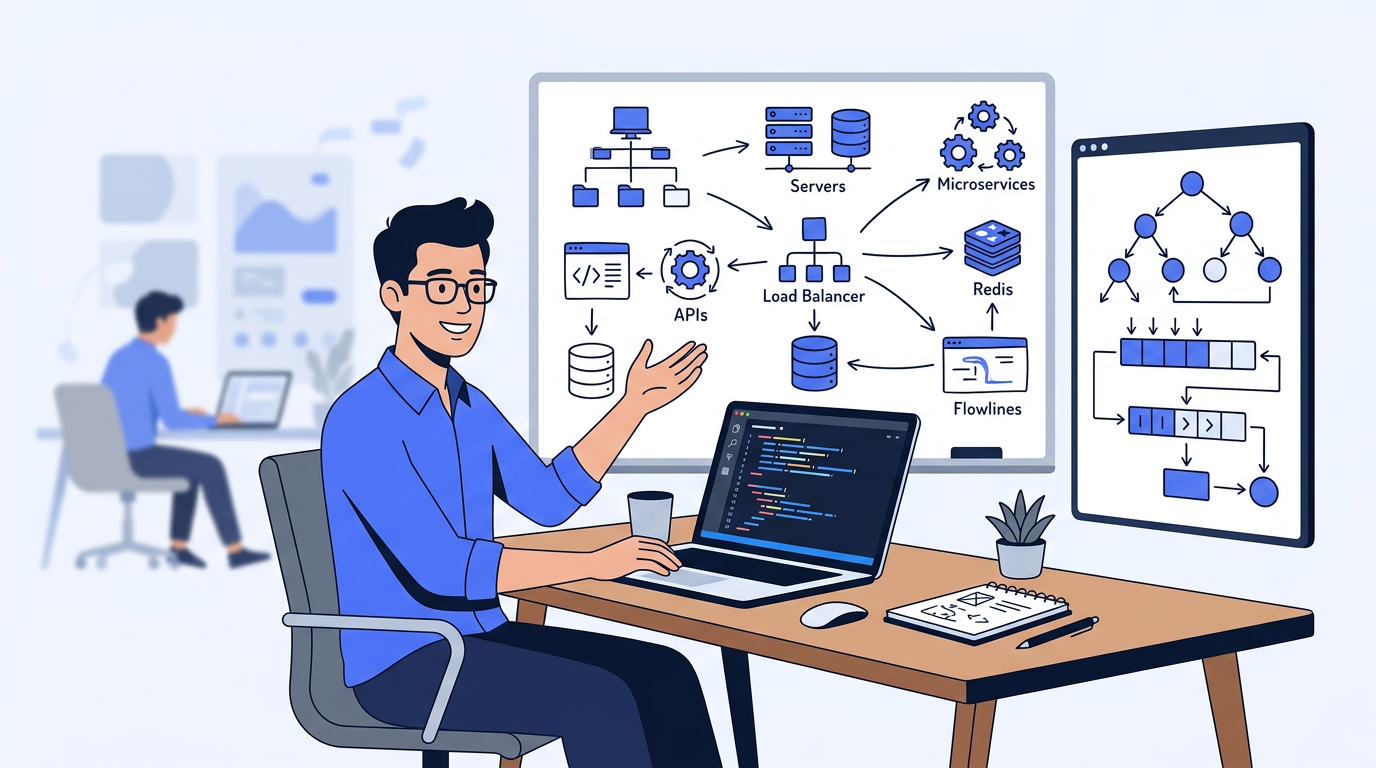
What software engineer interview panels evaluate
Software engineer interviews test three dimensions: coding ability, system design thinking, and behavioral fit. The panel is not just checking whether you can write a function — they are evaluating how you think under pressure, how you communicate technical concepts, and whether you will be a productive and collaborative team member. Every answer reveals both your technical depth and your engineering judgment.
Most SWE interviews include four components: a coding round (1-2 problems), a system design round, a behavioral round, and a culture fit discussion. Some companies combine coding and behavioral into one round, and some add a take-home project. The coding round is where most candidates are filtered, but the behavioral round is where finalists are chosen — technical skill gets you to the final round, but communication and judgment get you the offer.
Common questions and answer frameworks
Below are eighteen of the most frequently asked software engineer interview questions, each with a framework and a sample answer. Adapt the examples to your own experience. For engineers, specificity is critical — use real metrics, real technologies, and real tradeoffs in every answer.
Tell me about a challenging technical problem you solved.
Use STAR. Situation: Our API was timing out during peak traffic, affecting 15 percent of requests. Task: I needed to find and fix the root cause within 24 hours. Action: I profiled the slowest endpoint and found an N+1 query problem in the ORM — the code was fetching related records in a loop instead of a single join. I rewrote the query using a batch fetch, added a composite index, and implemented caching for the most common query patterns. Result: API response time dropped from 4.2 seconds to 180 milliseconds, and timeouts dropped to zero. I also added a query performance test to the CI pipeline to prevent regression. I learned that profiling before optimizing saves hours of guessing.
How do you approach system design questions?
Show a structured process. 'I start by clarifying requirements — functional, non-functional, and constraints. I estimate scale: users, QPS, data volume. Then I sketch a high-level architecture: load balancer, API layer, database, cache. I discuss tradeoffs at each decision point: SQL vs NoSQL, sync vs async, monolith vs microservices. I identify bottlenecks and propose mitigations: caching for read-heavy, queue for write-heavy, sharding for scale. I end with monitoring and failure modes. The key is not the final design — it is showing structured thinking and tradeoff awareness.'
What is your approach to writing clean code?
Show practical habits. 'I follow three principles: readability over cleverness, explicit over implicit, and small functions over large ones. I name variables and functions descriptively — getUserProfileById instead of getData. I keep functions under 30 lines and extract helpers when logic repeats. I write tests alongside the code, not after. I also review my own PR before requesting review — I read every diff and ask: would a new team member understand this without context? Clean code is code that is easy to change, not just code that works today.'
How do you handle technical debt?
Show a balanced approach. 'I do not treat technical debt as all-or-nothing. I categorize it: intentional debt (we chose speed over perfection for a reason), accidental debt (we did not know better), and rot (the code was fine but the context changed). I advocate for paying down debt in small increments — 20 percent of each sprint dedicated to refactoring, not a separate debt sprint that never gets prioritized. I also document debt in the issue tracker with the cost of not fixing it, so product managers understand the tradeoff. Debt is a tool, not a sin — but unmanaged debt is negligence.'
Describe a time you disagreed with a senior engineer on a technical decision.
Use STAR. Situation: A senior engineer wanted to use a new framework for a critical service, but I believed it was too early in its lifecycle. Task: I needed to express my concern without being insubordinate. Action: I researched the framework stability, community size, and migration path. I presented my concerns with data: the framework had 3 maintainers, no LTS policy, and 2 breaking changes in the last 6 months. I proposed using it for a non-critical service first to evaluate. Result: The senior engineer agreed to the pilot approach. The framework had a breaking change in month 3 that confirmed my concern, and we chose a more stable alternative. I learned that disagreement with data is not insubordination — it is engineering judgment.'
How do you test your code?
Be specific about layers. 'I test at three levels. Unit tests for individual functions — fast, isolated, and cover edge cases. Integration tests for API endpoints — verify the request-response cycle with a real or mock database. End-to-end tests for critical user flows — slower but catch issues that unit tests miss. I aim for 80 percent coverage on business logic and 100 percent on payment and auth flows. I also write tests before refactoring, not after — tests give me confidence that the refactor did not break anything. Tests are not overhead — they are the safety net that enables fast iteration.'
What programming languages are you most proficient in?
Be honest about depth. 'I am most proficient in TypeScript and Python. I have written TypeScript for four years in production — React frontend, Node.js backend, and shared types. I have used Python for three years for data processing, scripting, and ML model serving. I also have intermediate Go experience from a microservices project and basic Rust from personal projects. I learn new languages quickly — I picked up Go in two weeks by building a small service. I do not claim proficiency I do not have — I would rather say I am learning than pretend I know.'
How do you stay current with technology?
Show daily habits. 'I read Hacker News every morning for industry trends. I follow engineering blogs from companies I respect — Stripe, Netflix, Cloudflare. I subscribe to two newsletters: Refactoring for architecture and Pragmatic Engineer for career insights. I build side projects with new tools before using them at work — I built a small service in Rust to understand the borrow checker before recommending it. Staying current is not about knowing every framework — it is about understanding which trends matter and which are hype.'
Tell me about a time you optimized a performance bottleneck.
Use STAR. Situation: A report generation endpoint was taking 30 seconds for large datasets. Task: I needed to bring it under 3 seconds. Action: I profiled the endpoint and found three bottlenecks: a synchronous loop doing 200 database queries, no pagination, and rendering HTML server-side. I replaced the loop with a single batch query, added pagination, and moved rendering to the client. I also added a Redis cache for repeated reports. Result: Response time dropped from 30 seconds to 800 milliseconds — a 37x improvement. I learned that the biggest performance wins usually come from reducing database round-trips, not micro-optimizing code.'
How do you handle code reviews?
Show both giving and receiving. 'When reviewing, I focus on correctness, readability, and maintainability — not style preferences. I ask questions before making judgments: why did you choose this approach? What tradeoffs did you consider? I also suggest alternatives with reasoning, not commands. When receiving reviews, I do not take feedback personally — the reviewer is improving the code, not criticizing me. I respond to every comment, either with a fix or a justification. If I disagree, I explain my reasoning with data, not opinions. Code review is a conversation, not a verdict.'
What is your experience with microservices?
Be specific about tradeoffs. 'I have built and maintained microservices for three years. I understand the benefits: independent deployment, team autonomy, and technology flexibility. I also understand the costs: distributed system complexity, network latency, and operational overhead. In my last role, I helped migrate a monolith to microservices, but I also advocated for keeping the billing module as a monolith because it was tightly coupled and the migration cost was not justified. Microservices are not always the answer — they are a tradeoff between deployment independence and system complexity.'
How do you debug a production incident?
Show a calm, systematic process. 'First, I assess severity and mitigate: can I roll back, scale up, or redirect traffic? Then I investigate: check logs, metrics, and recent deployments. I form a hypothesis, test it, and iterate. I communicate with the team throughout — a shared Slack channel with timestamps so everyone sees the progression. Once the incident is resolved, I write a post-mortem: what happened, why, what we did, and what we will change to prevent it. I never blame individuals in a post-mortem — I blame systems and processes.'
Describe your experience with CI/CD.
Be specific about pipelines. 'I have built CI/CD pipelines using GitHub Actions and GitLab CI. A typical pipeline I built: lint on commit, unit tests on push, integration tests on PR, deploy to staging on merge, and deploy to production on tag. I also added automated rollback if health checks failed after deploy. I believe in trunk-based development with feature flags rather than long-lived branches — it reduces merge conflicts and keeps the main branch deployable. CI/CD is not just about automation — it is about confidence to deploy frequently.'
How do you handle on-call rotations?
Show reliability and boundaries. 'I take on-call seriously. When I am on call, I keep my phone charged and laptop accessible. I respond within the SLA — 15 minutes for critical. I document every incident in the on-call log with the same detail as a regular ticket. I also believe in sustainable rotations — no one should be on call more than one week per month. After an incident, I create an action item to reduce the likelihood of recurrence. The goal of on-call is not just to respond — it is to reduce future incidents.'
What is your approach to learning a new codebase?
Show a practical process. 'I start by running the project locally and clicking through the main user flows. Then I read the README, the architecture doc, and the directory structure. I pick a small bug or feature and implement it — nothing teaches you a codebase faster than making a change. I also ask for a code walkthrough from a team member — 30 minutes of guided tour saves days of self-discovery. I document what I learn in the wiki so the next person does not have to rediscover it. Learning a codebase is not memorization — it is pattern recognition.'
How do you balance speed and quality?
Show nuanced thinking. 'Speed and quality are not opposites — poor quality slows you down in the long run. I balance them by defining what must be right: correctness, security, and data integrity are non-negotiable. Code structure and tests can be good enough for now and improved later. I also use feature flags to ship behind a flag and iterate before exposing to all users. The question is not how fast can I build it — it is what is the minimum I need to ship to get feedback, and what can I improve after? Speed without quality is technical debt; quality without speed is over-engineering.'
Tell me about a time you mentored a junior engineer.
Use STAR. Situation: A junior engineer was struggling with a complex feature and becoming demotivated. Task: I needed to help them succeed while building their confidence. Action: I paired with them for 2 hours, broke the feature into 5 smaller tasks, and explained the why behind each step. I reviewed their PRs with detailed explanations, not just corrections. I also assigned them a stretch task that was slightly beyond their comfort zone. Result: They completed the feature in 4 days and started volunteering for complex tasks. They told me later that the pairing session was the most helpful thing anyone had done for them. I learned that mentoring is not doing the work for someone — it is making the work feel achievable.'
Why should we hire you for this software engineer role?
Connect your experience to their needs. Example: 'You should hire me because I combine technical depth with product thinking. In my last role, I reduced API latency by 37x, built a CI/CD pipeline that cut deploy time from 2 hours to 10 minutes, and mentored two junior engineers to independent contributors. I do not just write code — I write code that solves business problems, is maintainable by the team, and is tested well enough that I can sleep at night. I am an engineer who thinks about the product, not just the pull request.'
The STAR method for SWE behavioral questions
For behavioral questions, use the STAR method. In SWE interviews, your stories must demonstrate both technical competence and collaboration:
- Situation — What was the system, the scale, and the business impact?
- Task — What was the technical challenge you were responsible for?
- Action — What did you do? Describe the technical decisions, not just the outcome.
- Result — Quantify it: latency reduced, test coverage increased, deploy time shortened, incidents prevented.
Keep each STAR answer under 90 seconds. Engineers who ramble signal a lack of structure — and structure is exactly what the panel is testing. A complete example: "Our API was timing out for 15 percent of requests. I profiled the slowest endpoint, found an N+1 query, rewrote it as a batch fetch, and added an index. Response time dropped from 4.2 seconds to 180 milliseconds. I added a query performance test to CI to prevent regression."
Common mistakes to avoid
- Jumping into code without clarifying the problem — Always ask clarifying questions before writing a single line.
- Not explaining your thinking during coding — Silence is a red flag. Narrate your approach as you code.
- Over-engineering the solution — A simple correct solution beats a complex clever one. Start simple, then optimize.
- Not knowing your past project metrics — If you cannot state the impact of your work, the panel doubts your judgment.
- Dismissing behavioral questions as easy — Behavioral rounds are where offers are won or lost. Prepare for them seriously.
- Not asking about the engineering culture — If you do not ask about CI/CD, code review, and on-call, you signal you only care about the offer.
Step-by-step interview preparation method
Review data structures and algorithms
Practice arrays, hash maps, linked lists, trees, graphs, dynamic programming, and common patterns (sliding window, two pointers, BFS/DFS). Use LeetCode or similar. Focus on medium-difficulty problems — they are the most common in interviews.
Prepare system design fundamentals
Understand load balancing, caching, database sharding, message queues, CAP theorem, and horizontal vs vertical scaling. Practice designing a URL shortener, a chat system, and a news feed. Be ready to discuss tradeoffs, not just architecture.
Prepare 5 behavioral stories
Have STAR stories: a complex bug you fixed, a performance optimization, a technical disagreement, a mentoring moment, and a production incident. Each should show both technical skill and collaboration.
Practice coding aloud
In coding interviews, you must explain your thinking while you code. Practice talking through your solution as you write it. Use an AI interview tool to simulate the live coding experience and get feedback on your communication.
Research the company tech stack
Check their engineering blog, job description, and GitHub. Know their primary languages, frameworks, and infrastructure. If they use Kubernetes and you have experience, highlight it. If they use something you have not, be ready to discuss transferable skills.
Prepare questions about the engineering culture
Ask about the CI/CD pipeline, code review process, on-call rotation, tech debt strategy, and what the team is excited to build next. These show you care about the engineering environment, not just the offer.
Questions to ask the interview panel
- What is the CI/CD pipeline like, and how often do you deploy?
- How does the team handle code review and knowledge sharing?
- What is the on-call rotation like, and how are incidents handled?
- What is the biggest technical challenge the team is facing?
- How does the team balance new features with tech debt?
- What does success look like for this role in the first 90 days?
After the interview: follow-up and reflection
Within 24 hours, send a concise thank-you email. Reference a specific technical topic from the interview — a system design question they asked, a technology they mentioned, or a challenge they described. For engineers, this follow-up shows attention to detail and communication skill.
If you do not get the job, ask for feedback. SWE hiring decisions often come down to coding speed, system design depth, or cultural fit. The feedback tells you exactly what to practice before your next interview.
Practice with AI
Software engineer interview preparation is most effective when you practice coding aloud and simulate the live interview experience. Read the job description, identify the technologies and problem types most relevant, and rehearse your behavioral stories. Uhired AI can generate SWE-specific interview questions from your resume and the job description, simulate the live coding experience with real-time feedback, and help you refine your behavioral answers until they are concise and metrics-driven.
You can also use AI to simulate the system design round. Give the AI a problem — design a URL shortener, a chat system, a rate limiter — and practice walking through your design in 30 minutes. This builds the structured thinking and tradeoff communication that separates good engineers from great ones in the interview room.
Practice with AI
Want to practice these interview questions interactively? Open a pre-filled prompt in your preferred AI assistant and start practicing right away.