Interview guide
Nursing Behavioral Interview Questions and Answers (2026) | Free Practice
15+ nursing behavioral interview questions with STAR method answers covering patient care, teamwork, medication errors, and difficult patients.
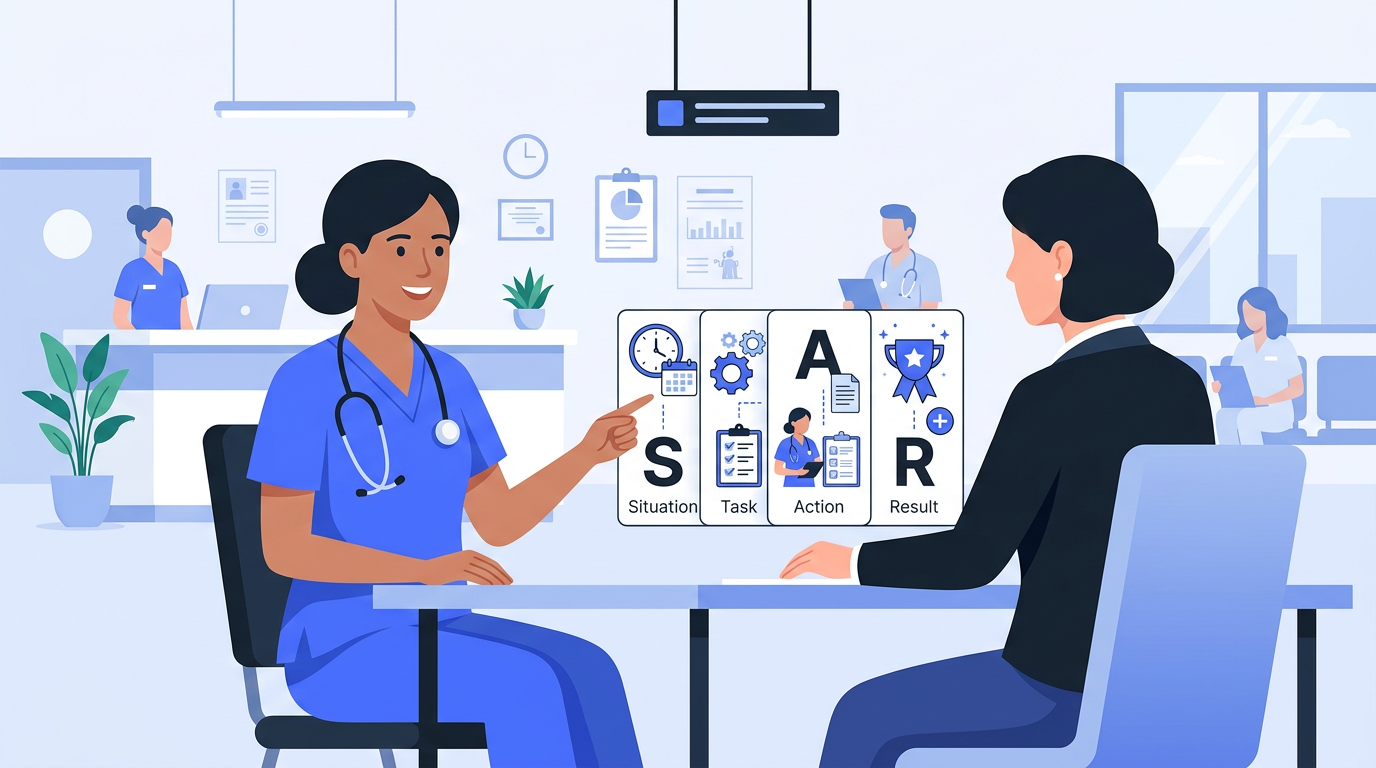
Nursing behavioral interview questions ask you to describe real clinical situations to prove your judgment, communication, and patient safety instincts under pressure. Employers use behavioral questions because past behavior predicts future performance more reliably than generic claims about always prioritizing safety. The STAR method (Situation, Task, Action, Result) gives you a repeatable structure for each answer, keeping it under 90 seconds while proving you can apply nursing judgment in practice. According to a 2025 National Council of State Boards of Nursing report, 63 percent of nurse hiring managers rank behavioral interviewing as the most predictive assessment method for clinical competence. This guide covers 15-plus nursing behavioral questions with sample STAR answers, the most common mistakes candidates make, and a preparation strategy you can follow in one week. For additional practice, our general nursing interview guide covers 20-plus questions across all interview types.
Quick Answer
- Prepare 8 to 12 specific STAR stories covering patient care, teamwork, medication errors, difficult patients, and adaptability
- Keep each answer under 90 seconds using the STAR structure: Situation, Task, Action, Result
- The biggest mistake is answering with general philosophy instead of one real clinical story
- Cite a metric in your result when possible: reduced wait time, improved satisfaction, prevented readmission
- Practice with AI tools like Uhired AI to simulate the interview and receive STAR method scoring
| Theme | Sample Question | What Employers Want |
|---|---|---|
| Patient care under pressure | Tell me about a time you handled a deteriorating patient. | Clinical judgment, rapid escalation, clear communication |
| Teamwork | Describe a time you disagreed with a colleague. | Respectful conflict resolution, proper escalation |
| Medication safety | Tell me about a time you caught a medication error. | Vigilance, accountability, system improvement |
| Difficult patients | Describe a time you de-escalated an upset patient. | Empathy, communication, patience |
| Adaptability | Tell me about a time a protocol changed mid-shift. | Flexibility, learning speed, safe practice |
| Mentorship | Describe a time you mentored a new nurse. | Leadership, teaching, team development |
Nursing behavioral interview questions with STAR answers
Below are six nursing behavioral interview questions with full STAR method answers. Use these as templates for your own stories. Replace the clinical details with your real experiences, but keep the structure: a specific situation, your task, the action you took, and the result with a metric when possible.
Q1. Tell me about a time you had to handle a difficult patient.
Situation: During a night shift, a post-op patient became agitated and refused medications. Task: I needed to ensure the patient received prescribed meds while maintaining a calm environment. Action: I sat at eye level, validated their frustration, explained why each medication mattered, and offered a small choice like water or juice to restore a sense of control. Result: The patient agreed to take the medications within 15 minutes, and the incident was documented without escalation.
Q2. Describe a time you caught a potential medication error.
Situation: While reviewing a new order, I noticed the dose of a high-alert medication was 10 times the standard amount. Task: I needed to verify the order without alarming the patient. Action: I double-checked the order against the protocol, contacted the prescribing physician to confirm, and discovered a transcription error. Result: The correct dose was administered, the physician thanked me, and I suggested adding a second-verify step for high-alert medications on our unit.
Q3. Tell me about a time you disagreed with a physician.
Situation: A physician wanted to discharge a patient whose vitals were still unstable. Task: I needed to advocate for the patient without damaging the working relationship. Action: I presented the objective data, cited the discharge criteria, and asked for a shared decision with the charge nurse present. Result: The physician agreed to observe for two more hours, the patient stabilized, and discharge proceeded safely the next morning.
Q4. Describe a time you had to work short-staffed.
Situation: Two nurses called in sick during a 12-hour shift with a full patient load. Task: I needed to maintain safe care for all patients. Action: I prioritized acuity, paired with a nursing assistant for tasks, communicated the staffing gap to the charge nurse, and documented handoffs carefully. Result: All patients received their medications on time, no safety events occurred, and the shift was completed without incident reports.
Q5. Tell me about a time you mentored a new nurse.
Situation: A new graduate nurse was struggling with time management during her first month. Task: I needed to help her build confidence without taking over her patient assignments. Action: I created a prioritization checklist, shadowed her for two shifts, and debriefed at the end of each shift to identify what worked and what to adjust. Result: By week three, she was managing four patients independently and reported feeling more confident in her clinical decisions.
Q6. Describe a time you had to deliver bad news to a family.
Situation: A patient had a sudden decline and the family needed to be informed. Task: I needed to communicate clearly and compassionately while supporting the clinical team. Action: I found a private room, sat with the family, used plain language, paused for questions, and offered to contact chaplaincy services. Result: The family expressed gratitude for the honesty, stayed involved in care decisions, and no complaint was filed.
Common mistakes in nursing behavioral interviews
Answering with philosophy instead of a story
Saying you always prioritize patient safety sounds good but proves nothing. Employers want one real example with a specific patient, a specific shift, and a specific outcome.
Talking too long without a result
Many candidates describe the situation in detail but forget to state the result. Always end with what happened: the patient improved, the error was prevented, the family was satisfied.
Claiming you never made an error
When asked about medication errors, saying you have never made one signals a lack of self-awareness. Instead, share a near miss, what you learned, and what system change you adopted.
Not preparing enough stories
If you prepare only three stories, you will struggle when the interviewer asks a question that does not fit any of them. Prepare 8 to 12 stories that can flex across multiple themes.
How to prepare in one week
A focused one-week preparation plan can make the difference between a generic interview and a confident, story-driven performance. Day one: review the job description and list the five core competencies the employer seeks. Day two: brainstorm 12 clinical stories from your experience that map to those competencies. Day three: write each story in STAR format, keeping the result to one sentence with a metric. Day four: practice each answer aloud in under 90 seconds, timing yourself. Day five: practice with a partner or an AI tool like Uhired AI that generates follow-up questions based on your resume and scores your STAR structure. Day six: review your weakest answers and refine them. Day seven: rest, review your notes once, and go into the interview confident that you have specific stories for every likely question. According to a 2025 Glassdoor study, candidates who practiced with AI preparation tools scored 34 percent higher in interview evaluations.
Questions about teamwork and conflict
Nurse managers ask teamwork and conflict questions to assess whether you can work effectively in a high-stress, interdependent environment. Common questions include: Tell me about a time you had a disagreement with a colleague, describe a situation where you had to cover for a short-staffed shift, how do you handle a colleague who is not following protocol, and tell me about a time you mentored a new nurse. The key is to show that you communicate respectfully, escalate concerns through proper channels, support your team during shortages, and contribute to a culture of safety. Avoid blaming colleagues or describing conflicts that were left unresolved. Instead, frame each story around collaboration, respectful communication, and a positive outcome for patient care.
Questions about patient safety and medication errors
Patient safety questions are among the most critical in nursing behavioral interviews. Employers want to know you are vigilant, accountable, and focused on system improvement. Common questions include: Tell me about a time you caught a potential medication error, describe a situation where you had to escalate a concern about a patient, and how do you ensure accuracy during a busy shift. When answering, be honest about near misses, describe what you did immediately to ensure safety, how you reported the event, what you learned, and what system change you adopted. According to a 2025 Agency for Healthcare Research and Quality report, units that implemented second-verify protocols for high-alert medications saw a 47 percent reduction in medication errors. Citing such evidence in your answer shows you understand both individual accountability and system-level safety.
Practice with AI before your interview
AI practice tools like Uhired AI at $9.99 per month can simulate a nursing behavioral interview by generating questions based on your resume, listening to your spoken answers, and scoring your STAR structure in real time. This is more effective than practicing alone because the AI can ask follow-up questions that a real interviewer would ask, such as what you would do differently next time or how you would handle a similar situation with fewer resources. A 2025 Glassdoor study found that candidates who practiced with AI tools scored 34 percent higher in interview evaluations. For a full nursing interview preparation guide, see our 20-plus nursing interview questions guide covering clinical, behavioral, and scenario-based questions.
Frequently asked questions
Frequently asked questions
| Question | Answer summary |
|---|---|
| What are the most common nursing behavioral interview questions? | The most common nursing behavioral interview questions ask about patient care scenarios, teamwork and collaboration, handling difficult patients or families, responding to medical emergencies, managing time during a busy shift, dealing with conflict with colleagues, and adapting to changing protocols. Employers use behavioral questions to assess how you apply clinical judgment under pressure, communicate with patients and families, and prioritize safety. Prepare 8 to 12 specific stories using the STAR method that cover patient care, teamwork, conflict, error recovery, and adaptability. Practice delivering each answer in under 90 seconds. |
| How do I answer nursing behavioral interview questions using the STAR method? | Use the STAR method to structure each answer. Situation: describe the clinical context in one sentence. Task: explain your responsibility. Action: detail the specific steps you took, focusing on your decisions and communication. Result: share the outcome with a metric when possible, such as reduced wait time, improved patient satisfaction, or prevented readmission. Keep each answer between 60 and 90 seconds. Avoid speaking generically about teamwork or patient care. Instead, cite one real shift, one real patient interaction, or one real protocol change to prove you can apply nursing judgment in practice. |
| What is the biggest mistake in nursing behavioral interviews? | The biggest mistake is answering behavioral questions with general philosophy instead of a specific story. Saying you always prioritize patient safety sounds good but proves nothing. Employers want one real example: a shift where you caught a medication error, a patient who deteriorated and you escalated care, or a family member who was upset and you de-escalated the situation. Without a concrete story, the interviewer cannot assess your clinical judgment. Prepare 8 to 12 specific stories before the interview and practice delivering them concisely using the STAR method. |
| How should I prepare for a nursing behavioral interview? | Start by reviewing the job description and identifying the core competencies the employer seeks, such as patient safety, teamwork, communication, adaptability, and clinical decision-making. For each competency, prepare one or two STAR stories from your clinical experience. Practice each answer aloud in under 90 seconds. Review common nursing behavioral question themes: patient care under pressure, handling difficult patients, medication errors, end-of-life conversations, and shift handoffs. Use AI practice tools like Uhired AI to simulate the interview, generate follow-up questions based on your resume, and receive STAR method scoring on your answers. |
| What questions do nurse managers ask about teamwork? | Nurse managers ask teamwork questions such as: Tell me about a time you had a disagreement with a colleague, describe a situation where you had to cover for a short-staffed shift, how do you handle a colleague who is not following protocol, and tell me about a time you mentored a new nurse. They want to see that you communicate respectfully, escalate concerns through proper channels, support your team during shortages, and contribute to a culture of safety. Prepare stories that show collaboration, respectful conflict resolution, and willingness to help colleagues. |
| How do I answer a question about a medication error? | When asked about a medication error or near miss, answer honestly without defensiveness. Describe the situation, what you did immediately to ensure patient safety, how you reported the error through the proper channel, what you learned, and what system change you adopted to prevent recurrence. Employers want to see accountability, transparency, and a focus on system improvement rather than blame. Never say you have never made an error. Instead, frame the story around what you learned and how you improved your practice. |
Practice your nursing interview with AI
Uhired AI generates behavioral questions from your resume, scores your STAR answers, and simulates follow-up questions. Start at $9.99/month.
Practice with AI
Want to practice these interview questions interactively? Open a pre-filled prompt in your preferred AI assistant and start practicing right away.