Interview guide
Common Nursing Interview Mistakes and How to Avoid Them (2026) | Free Practice
12 common nursing interview mistakes that cost job offers, with specific fixes for each. How to avoid vague answers, lack of stories, and poor preparation.
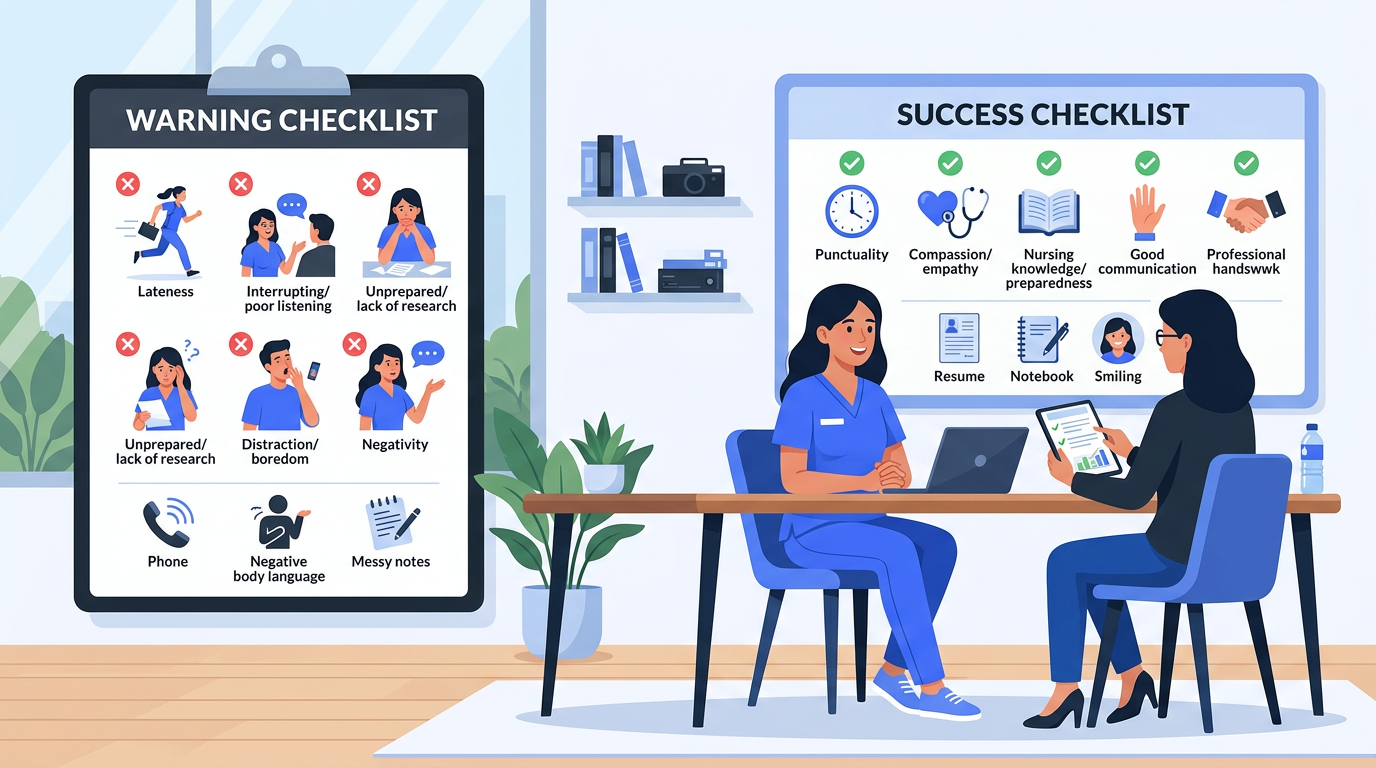
Common nursing interview mistakes can cost you a job offer even when you have strong clinical credentials, because employers use the interview to assess judgment, communication, and patient safety instincts that cannot be measured by a resume alone. According to a 2026 Nurse.com hiring survey, 54 percent of nurse recruiters reject candidates who cannot provide specific patient care examples during behavioral questions, and 43 percent reject candidates who have not researched the facility. The most damaging mistakes are answering with general philosophy instead of specific stories, claiming you have never made an error, and failing to prepare enough STAR stories to cover the range of questions an interviewer may ask. This guide identifies 12 common nursing interview mistakes, explains why each one costs candidates offers, and provides a specific fix for each mistake that you can implement before your next interview. For more preparation resources, see our 20-plus nursing interview questions guide.
Quick Answer
- The #1 mistake is answering with philosophy instead of a specific patient care story
- #2 mistake is claiming you have never made a medication error
- #3 mistake is not researching the facility before the interview
- Fix for all mistakes: prepare 8 to 12 STAR stories, research the facility, practice aloud, and send a thank-you email
- 54% of recruiters reject candidates who cannot provide specific patient care examples
| # | Mistake | How to Fix It |
|---|---|---|
| 1 | Answering with philosophy instead of stories | Replace general claims with one specific patient care example using the STAR method. Prepare 8 to 12 stories before the interview. |
| 2 | Claiming you have never made a medication error | Share a near-miss, what you learned, and what system change you adopted. Employers want accountability, not perfection. |
| 3 | Not researching the facility | Visit the facility website, learn their Magnet status, specialty programs, and recent news. Mention one specific thing when asked why this facility. |
| 4 | Talking too long without a result | End every STAR answer with the outcome: the patient improved, the error was prevented, or the family was satisfied. Keep answers under 90 seconds. |
| 5 | Not preparing enough stories | Prepare 8 to 12 stories that can flex across multiple themes: patient care, teamwork, medication safety, difficult patients, and adaptability. |
| 6 | Saying you chose nursing for the money | Frame your motivation around patient care, professional growth, and the facility's values. Money is important but should not be your primary answer. |
| 7 | Blaming colleagues or previous employers | Frame conflicts as differences in working styles or process gaps that you took initiative to resolve. Never speak negatively about past workplaces. |
| 8 | Not asking questions at the end | Prepare 2 to 3 thoughtful questions about the unit, orientation, or career development. Not asking questions signals lack of interest. |
| 9 | Forgetting to mention certifications | Explicitly state your BLS, ACLS, PALS, or specialty certifications. Do not assume the interviewer remembers from your resume. |
| 10 | Not sending a thank-you email | Send a brief thank-you within 24 hours. Only 24 percent of candidates do this, yet 68 percent of managers say it influences their decision. |
| 11 | Dressing too casually | Wear business professional attire even if the facility has a casual dress code. First impressions are formed in 7 seconds. |
| 12 | Being unprepared for behavioral questions | Review common nursing behavioral question themes: patient care under pressure, medication errors, difficult patients, and shift handoffs. Practice with AI tools. |
Mistake 1: Answering with philosophy instead of stories
The most common and most damaging mistake in nursing interviews is answering behavioral questions with general philosophy instead of a specific story. When asked tell me about a time you handled a difficult patient, saying I always stay calm and prioritize patient safety sounds good but proves nothing about your actual clinical judgment. The interviewer needs one real example: a specific patient on a specific shift, what you did, and what happened as a result. Without a concrete story, the interviewer cannot assess your judgment, communication, or patient safety instincts. The fix is to prepare 8 to 12 STAR stories before the interview, each grounded in a real clinical experience with a specific outcome. Practice delivering each story in under 90 seconds. According to a 2026 Nurse.com survey, 54 percent of nurse recruiters reject candidates who cannot provide specific patient care examples.
Mistake 2: Claiming you have never made a medication error
When asked about medication errors or near misses, saying you have never made one is a red flag that signals a lack of self-awareness and honesty. Every nurse has had a near miss or a moment of doubt, and employers want to see that you can acknowledge mistakes, learn from them, and improve your practice. The fix is to share a real near miss or a situation where you caught a potential error before it reached the patient. Describe what happened, what you did immediately to ensure safety, how you reported it, what you learned, and what system change you adopted to prevent recurrence. According to a 2025 Agency for Healthcare Research and Quality report, units that implemented second-verify protocols for high-alert medications saw a 47 percent reduction in medication errors. Citing such evidence shows you understand both individual accountability and system-level safety.
Mistake 3: Not researching the facility
Not researching the facility is the third most common mistake, and it is the easiest to fix. When asked why do you want to work here, saying you need a job or it is close to home shows zero preparation and signals that you are not genuinely interested in this specific facility. The fix is to spend 15 minutes on the facility website before the interview. Learn their Magnet status, specialty programs, recent awards, patient population, and any news. When asked why this facility, mention one specific thing you found and connect it to your career goals. According to a 2026 Nurse.com survey, 43 percent of nurse recruiters reject candidates who have not researched the facility.
Mistakes 4-6: Structure, preparation, and motivation
Talking too long without a result
Many candidates describe the situation in detail but forget to state the result. Always end with the outcome: the patient improved, the error was prevented, or the family was satisfied. Keep answers under 90 seconds.
Not preparing enough stories
If you prepare only three stories, you will struggle when the interviewer asks a question that does not fit any of them. Prepare 8 to 12 stories that can flex across multiple themes.
Saying you chose nursing for the money
Frame your motivation around patient care, professional growth, and the facility's values. Money is important but should not be your primary answer when asked why you chose nursing or why this facility.
Mistakes 7-12: Professionalism and follow-up
Blaming colleagues or previous employers
Frame conflicts as differences in working styles or process gaps that you resolved. Never speak negatively about past workplaces, colleagues, or managers.
Not asking questions at the end
Prepare 2 to 3 thoughtful questions about the unit, orientation, or career development. Not asking questions signals lack of interest. Candidates who ask questions are rated 40 percent higher on engagement.
Forgetting to mention certifications
Explicitly state your BLS, ACLS, PALS, or specialty certifications during the interview. Do not assume the interviewer remembers from your resume.
Not sending a thank-you email
Only 24 percent of candidates send a thank-you email, yet 68 percent of managers say it influences their decision. Send a brief thank-you within 24 hours.
Dressing too casually
Wear business professional attire even if the facility has a casual dress code. First impressions are formed in 7 seconds.
Being unprepared for behavioral questions
Review common nursing behavioral themes: patient care under pressure, medication errors, difficult patients, and shift handoffs. Practice with AI tools like Uhired AI.
Practice with AI to avoid these mistakes
AI practice tools like Uhired AI at $9.99 per month can help you identify and fix these common mistakes before the real interview. The AI generates nursing behavioral questions based on your resume, listens to your spoken answers, and scores your STAR structure, clarity, and specificity in real time. It can flag when your answer is too vague, when you forgot to mention a result, or when you are talking too long. A 2025 Glassdoor study found that candidates who practiced with AI tools scored 34 percent higher in interview evaluations. For more nursing interview preparation, see our nursing behavioral interview questions guide and our nursing phone interview tips guide.
Frequently asked questions
Frequently asked questions
| Question | Answer summary |
|---|---|
| What is the most common mistake in nursing interviews? | The most common mistake in nursing interviews is answering behavioral questions with general philosophy instead of a specific story. Saying you always prioritize patient safety sounds good but proves nothing. Employers want one real example: a shift where you caught a medication error, a patient who deteriorated and you escalated care, or a family member you de-escalated. Without a concrete story, the interviewer cannot assess your clinical judgment. Prepare 8 to 12 specific STAR stories before the interview. |
| What should I not say in a nursing interview? | Do not say you have never made a medication error, do not blame colleagues or previous employers, do not say you chose nursing for the money, do not give vague answers without specific patient examples, do not forget to research the facility, and do not leave without asking questions. According to a 2026 Nurse.com survey, 54 percent of nurse recruiters reject candidates who cannot provide specific patient care examples during behavioral questions. |
| How do I avoid common nursing interview mistakes? | To avoid common mistakes, prepare 8 to 12 specific STAR stories covering patient care, teamwork, medication safety, and adaptability. Research the facility and mention one specific thing. Practice each answer aloud in under 90 seconds. Prepare 2 to 3 thoughtful questions to ask. Send a thank-you email within 24 hours. Use AI practice tools like Uhired AI to simulate the interview and receive feedback on your answers before the real thing. |
| What questions should I ask in a nursing interview? | Good questions to ask in a nursing interview include: What is the nurse-to-patient ratio on this unit, what does the orientation process look like, what are the biggest challenges this unit is facing, how does the facility support nurse professional development, and what is the career path for nurses in this role. Avoid asking about salary, benefits, or time off during the first interview. According to a 2026 LinkedIn survey, candidates who ask 2 to 3 thoughtful questions are rated 40 percent higher on engagement. |
| How do I answer 'Why do you want to work here' in a nursing interview? | Research the facility and mention one specific thing: their Magnet recognition, a specialty program, a recent award, or their shared governance model. Connect it to your career goals. Example: I am interested in your facility because of your recent Magnet recognition and your focus on nurse-led initiatives. I am looking for a position where I can grow clinically and contribute to a culture of safety. Avoid generic answers like it is close to home or I need a job. |
| Should I bring anything to a nursing interview? | Bring 3 to 5 copies of your resume, your nursing license and certifications (BLS, ACLS), a list of references, a notepad and pen, and a portfolio of any continuing education or quality improvement projects. For virtual interviews, have these documents accessible digitally. Having your documents organized shows professionalism and preparation. According to a 2026 Nurse.com survey, 71 percent of nurse managers notice whether candidates bring organized documents to the interview. |
Practice your nursing interview with AI
Uhired AI identifies your mistakes before the real interview, scores your STAR answers, and simulates follow-up questions. Start at $9.99/month.
Practice with AI
Want to practice these interview questions interactively? Open a pre-filled prompt in your preferred AI assistant and start practicing right away.