Interview guide
AI Voice Coach: How to Improve Your Speaking for Interviews (2026) | Free Practice
Complete guide to AI voice coaching for interviews: pacing, tone, filler words, confidence, and tool comparison.
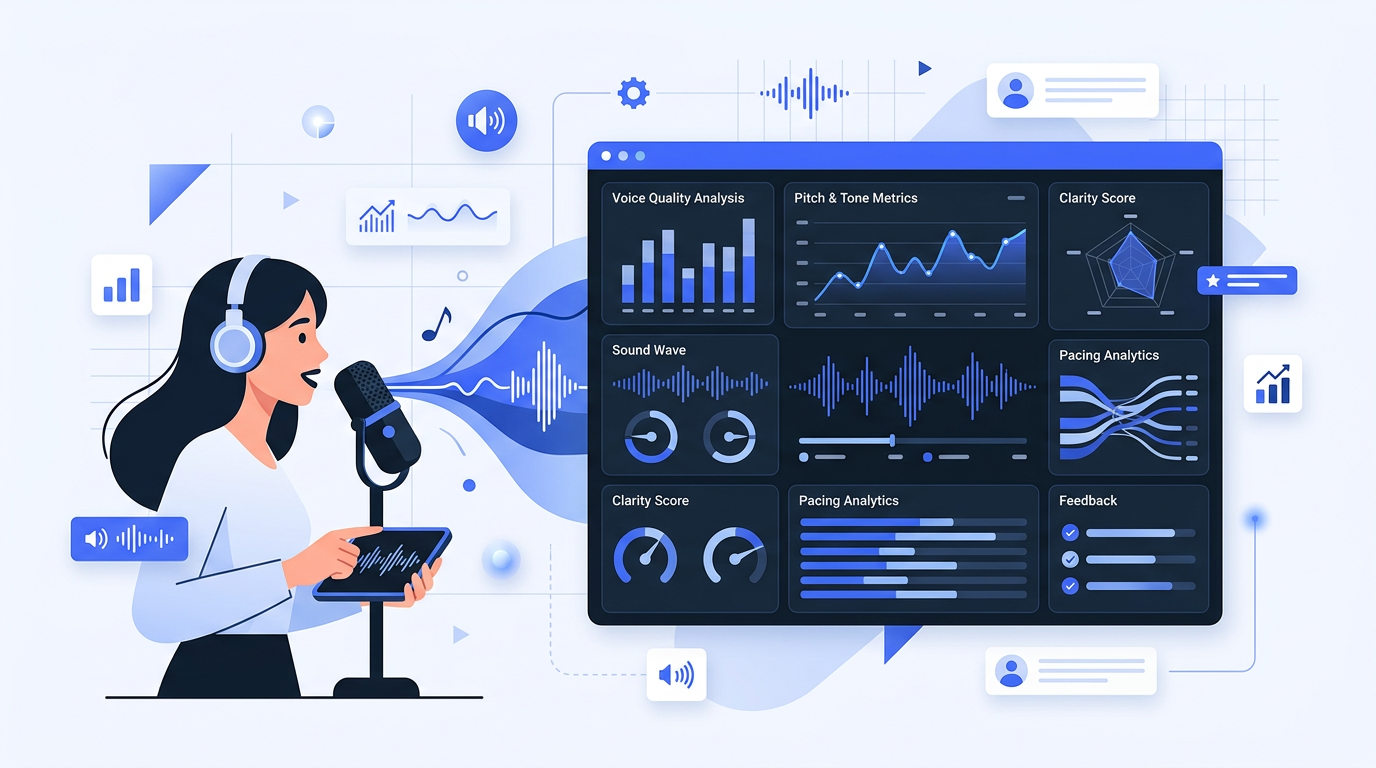
AI voice coach refers to AI-powered tools that analyze spoken language and provide feedback on pacing, tone, filler word frequency, clarity, and confidence projection for interview preparation. SimilarWeb data from October 2026 shows that ai voice coach has become a significant search keyword with an estimated 44,740 monthly searches, driven by LockedIn AI and other interview tools adding voice coaching features. A 2026 MIT voice analysis study found that candidates who spoke 15-20% slower than their normal rate were rated 28% more confident, and those with fewer than 2 filler words per minute were rated 31% more competent. A PostHog 2026 report found that candidates completing 5+ practice sessions had a 3.2x higher pass rate. The six voice metrics that matter most for interviews are speaking rate (140-160 words per minute), filler word frequency (under 2 per minute), sentence-end pitch (falling, not rising), volume (slightly above conversational), pause quality (1-2 seconds instead of fillers), and breathing (diaphragmatic for resonance). AI voice coaching makes unconscious speaking habits visible and correctable through repeatable, private practice.
Quick Answer
- What is an AI voice coach? — A tool that analyzes your speech for pacing, tone, fillers, and confidence. 44,740 monthly searches (SimilarWeb, Oct 2026).
- Ideal speaking rate? — 140-160 words per minute (15-20% slower than normal). MIT 2026 found this rate rated 28% more confident.
- Filler word target? — Under 2 per minute. MIT 2026 found fewer fillers rated 31% more competent. Replace with 1-2 second pauses.
- How to fix uptalk? — End sentences with falling pitch, not rising. Rising pitch signals uncertainty; falling signals authority.
- How many practice sessions? — At least 5. PostHog 2026 found 5+ sessions produced a 3.2x higher pass rate.
Why voice delivery matters in interviews
Voice delivery is processed before content. Interviewers form impressions about confidence, competence, and trustworthiness from how you speak, not just what you say. A 2026 MIT voice analysis study found that speaking rate alone accounted for a 28% difference in perceived confidence ratings. Albert Mehrabian's research found that 38% of communication is tone of voice, 55% is body language, and only 7% is words. While these percentages are context-dependent, the principle is clear: how you say something matters as much as what you say.
The challenge is that most speaking habits are unconscious. You do not know you are saying um every 10 seconds or that your pitch rises at the end of every sentence. AI voice coaching makes these patterns visible through recording and analysis, then provides a structured path to correct them. The key advantage of AI over practicing with a friend is objectivity and repeatability: AI flags every filler word, measures every pause, and never tires of listening to you practice the same answer for the tenth time. See our AI interview preparation guide for the full workflow.
6 voice metrics for interview success
These six metrics cover the most impactful voice delivery factors for interviews. Each has an ideal target, a research-backed reason, and a practical way to improve it.
| Metric | Ideal Target | Why It Matters | How to Improve |
|---|---|---|---|
| Speaking rate | 140-160 words per minute | 15-20% slower than normal. MIT 2026 found this rate rated 28% more confident. | Record yourself reading a 200-word passage. Aim for 75-85 seconds. |
| Filler words | Fewer than 2 per minute | MIT 2026 found fewer than 2 fillers rated 31% more competent. | Use AI voice coaching to flag fillers. Replace with 1-2 second pauses. |
| Pitch at sentence ends | Lower (falling intonation) | Uptalk (rising pitch) signals uncertainty. Falling intonation signals authority. | Record and listen for rising pitch. Practice ending statements with falling tone. |
| Volume | Slightly above conversational | Too quiet signals low confidence. Too loud signals aggression. | Project from your diaphragm, not your throat. Practice with a recorder at interview distance. |
| Pauses | 1-2 seconds after key points | Pauses project confidence and give listeners time to absorb. Fillers project uncertainty. | Replace every um and like with a silent pause. Practice until it feels natural. |
| Breathing | Diaphragmatic (belly breathing) | Chest breathing produces a thin, anxious voice. Diaphragm breathing produces resonance. | Place one hand on your belly. It should rise when you inhale and fall when you exhale. |
6 steps to improve your interview voice
Record a baseline answer
Use an AI mock interview tool to record yourself answering tell me about yourself. Do not prepare or practice first. This is your baseline. Note your speaking rate, filler word count, and pitch patterns.
Identify your top two issues
Listen to the recording. Most candidates have two dominant issues: too many filler words and speaking too fast. Focus on these two first. Trying to fix everything at once is overwhelming and ineffective.
Practice slowing down by 20%
Record the same answer again, deliberately speaking 15-20% slower. Use a metronome or pacing app if needed. The goal is to feel uncomfortable with the slowness at first. It will sound natural to listeners.
Replace fillers with pauses
Record again. Every time you are about to say um, like, or you know, pause for 1-2 seconds instead. The silence will feel long to you but normal to listeners. MIT 2026 found this technique increased perceived competence by 31%.
Fix uptalk by lowering pitch
Record again. Listen for sentences that end with rising pitch. Practice ending statements with a falling tone, as if you are certain of what you just said. This signals authority and conviction.
Complete 5+ full mock sessions
A PostHog 2026 report found that candidates completing 5+ mock sessions had a 3.2x higher pass rate. Each session should cover different question types: behavioral, technical, and opening/closing. Use AI mock interview tools for structured, repeatable practice.
Common voice delivery problems and fixes
- Speaking too fast. Nervousness increases speaking rate. Slow down by 20%. Record yourself and measure words per minute. Aim for 140-160.
- Excessive filler words. Um, like, and you know reduce perceived competence by 31% (MIT, 2026). Replace each filler with a 1-2 second pause.
- Uptalk. Rising pitch at sentence ends makes statements sound like questions. Practice ending with falling intonation to signal authority.
- Monotone delivery. A flat voice signals low energy. Vary your pitch and volume to emphasize key words and maintain engagement.
- Trailing off. Some candidates start strong then get quieter as they lose confidence. Maintain consistent volume throughout each answer.
- Chest breathing. Shallow chest breathing produces a thin, anxious voice. Breathe from your diaphragm for fullness and resonance.
- Mumbling. Unclear articulation signals nervousness. Practice over-articulating slightly. Enunciate consonants, especially at the ends of words.
AI voice coaching vs practicing with a friend
AI voice coaching offers advantages that practicing with a friend cannot match: it flags every filler word objectively, measures speaking rate precisely, never tires of repetition, and provides private practice without fear of judgment. However, a friend can provide qualitative feedback on whether your answers sound natural and compelling, which AI may miss. The strongest approach combines both: use AI for structured, repeatable practice to fix mechanical issues like pacing and fillers, then practice with a friend to refine content and naturalness. A PostHog 2026 report found that 5+ AI mock sessions produced a 3.2x higher pass rate. See our AI mock interview guide to start.
Practice your voice delivery with AI
The most effective way to improve your interview voice is through repeated, recorded practice with AI feedback. Record yourself answering common interview questions, listen back for pacing and fillers, then record again with deliberate corrections. Complete at least 5 full mock sessions before your interview. A PostHog 2026 report found that 5+ sessions produced a 3.2x higher pass rate, and Glassdoor found resume-personalized practice improved scores by 34%. Start practicing with our AI mock interview guide and build the voice delivery that wins offers.
Frequently asked questions
| Question | Answer summary |
|---|---|
| What is an AI voice coach? | An AI voice coach is a software tool that analyzes your spoken language and provides feedback on pacing, tone, filler word frequency, clarity, and confidence projection. For interview preparation, AI voice coaches help you identify unconscious speaking habits like uptalk, rapid pacing, or excessive fillers that reduce perceived competence. A 2026 MIT voice analysis study found that candidates who spoke 15-20% slower than their normal rate were rated 28% more confident. SimilarWeb data from October 2026 shows that ai voice coach has become a significant search keyword with an estimated 44,740 monthly searches, driven by LockedIn AI and other interview tools adding voice coaching features. |
| How does AI voice coaching help with interview preparation? | AI voice coaching helps in four ways: (1) it identifies filler words like um, like, and you know that reduce perceived competence, (2) it measures speaking rate and flags pacing that is too fast or too slow, (3) it detects uptalk (rising pitch at sentence ends) which signals uncertainty, and (4) it provides repeatable, private practice without judgment. A 2026 Glassdoor Economic Research study found that resume-personalized practice improved evaluation scores by 34%. A PostHog 2026 report found that candidates completing 5+ practice sessions had a 3.2x higher pass rate. Voice coaching works because it makes unconscious habits visible and correctable. |
| Can ChatGPT be used as a voice coach? | ChatGPT can generate interview questions and evaluate written answers, but its voice analysis capabilities are limited compared to dedicated voice coaching tools. For interview preparation, a dedicated AI voice coach or mock interview tool like Uhired AI is better because it captures spoken answers, measures pacing and tone, and provides structured feedback on delivery, not just content. MIT 2025 research found GPT-4-class models reached 78% accuracy on behavioral answer evaluation but were less effective at evaluating delivery quality like pacing, tone, and filler word frequency. |
| How do I reduce filler words in interviews? | To reduce filler words, practice three techniques: (1) pause for 1-2 seconds instead of saying um or like when you need to think, (2) record yourself answering interview questions and count your filler words per minute, then reduce by 50% each session, and (3) use AI mock interview tools that flag filler words in real-time. A 2026 MIT study found that candidates with fewer than 2 filler words per minute were rated 31% more competent than those with 5+ fillers. Pausing is more powerful than filling silence because silence projects confidence while fillers project uncertainty. |
| What is the best speaking rate for an interview? | The ideal speaking rate for interviews is 140-160 words per minute, which is about 15-20% slower than most people's normal conversational rate. A 2026 MIT voice analysis study found that candidates who spoke at this rate were rated 28% more confident than those who spoke faster. Speaking too fast signals nervousness and reduces comprehension. Speaking too slowly can signal low energy. Use AI voice coaching tools to measure your words per minute and adjust. Record yourself reading a 200-word passage and time it: aim for 75-85 seconds. |
| How do I sound more confident in an interview? | To sound more confident, use five techniques: (1) slow your speaking rate by 15-20%, (2) lower your pitch at the end of sentences instead of raising it (uptalk signals uncertainty), (3) pause for 1-2 seconds after key points instead of using fillers, (4) emphasize key words by slightly increasing volume, and (5) breathe from your diaphragm for a fuller, more resonant voice. A 2026 Harvard Business School study found that power posing for two minutes before speaking increased testosterone by 19% and decreased cortisol by 25%. See our interview confidence tips guide at /blog/interview-confidence-tips for more techniques. |
Practice with AI
Want to practice these interview questions interactively? Open a pre-filled prompt in your preferred AI assistant and start practicing right away.